Browse all articles in
System Update
System Update
0
min read
Updates to Streamline Your Records
We’re always working to make PACKTRACK faster and more user-friendly for handlers, trainers, and supervisors. Today, we’re excited to highlight several new improvements designed to save you time and improve communication across your team.
We’re always working to make PACKTRACK faster and more user-friendly for handlers, trainers, and supervisors. Today, we’re excited to highlight several new improvements designed to save you time and improve communication across your team.
Attach Documents to Events and Exercises
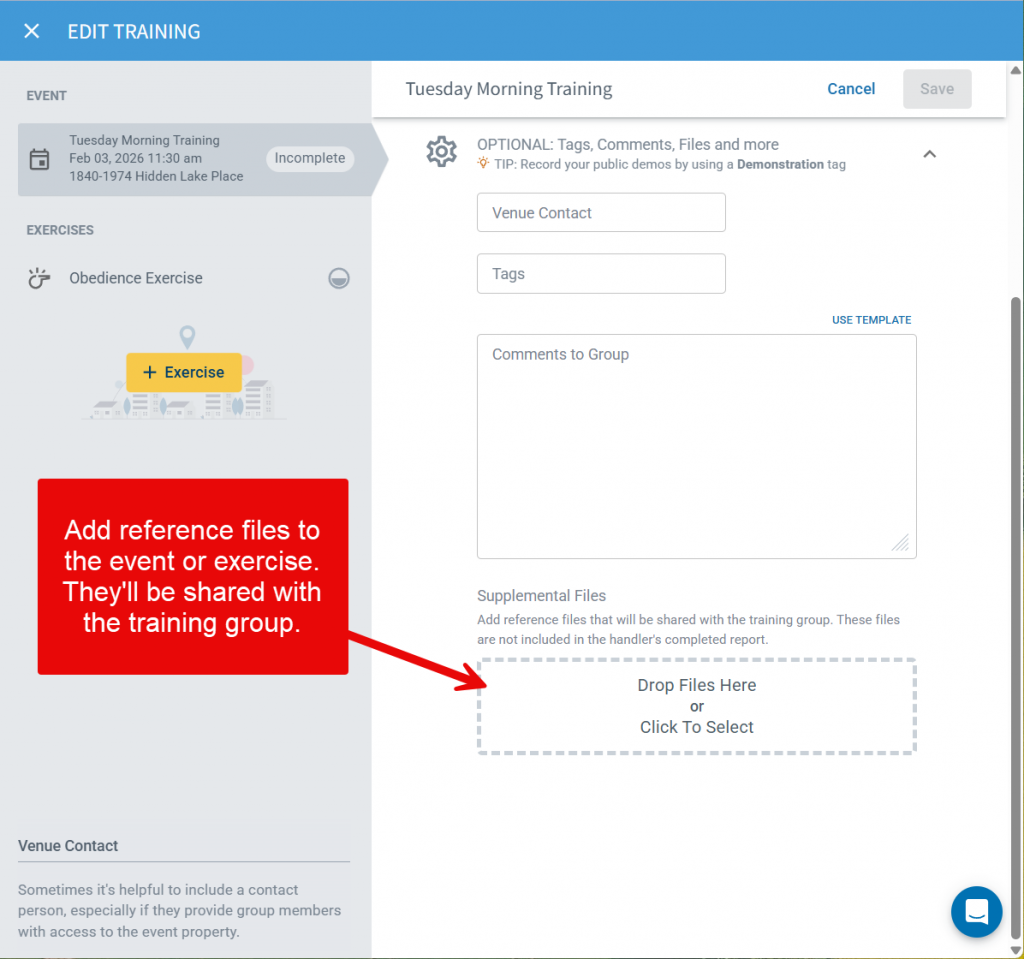
You’ve always been able to upload documents to individual exercise completions — but now you can include them directly in Events and Exercise definitions as well. This update gives handlers and trainers more flexibility to provide supplemental materials such as training outlines, reference documents, maps, diagrams, etc. Adding documents at the event or exercise level ensures everyone starts with the same information and supports more consistent, well-documented training.
Faster Data Entry with Autocomplete Locations
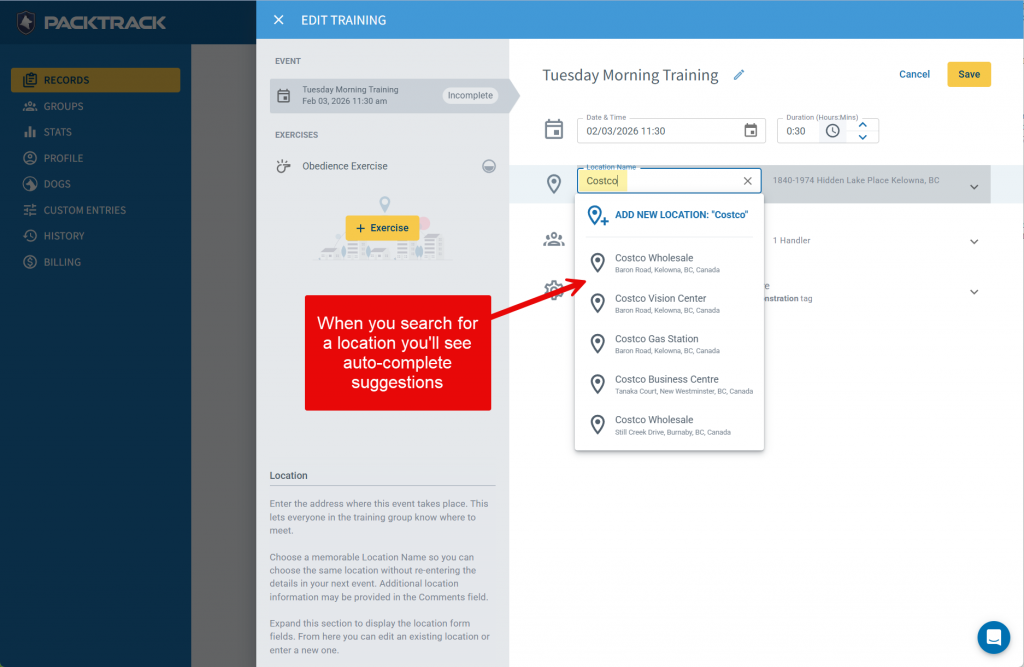
Recording where an event or deployment occurred is now even faster. PACKTRACK’s training and deployment forms now include Google-powered location autocomplete. Just start typing a name or address and nearby matching suggestions will appear. Select the correct option, and PACKTRACK will automatically fill in the relevant location fields for you. This means less typing, fewer mistakes and more accurate location data.
Supervisor Notifications for Completed Records
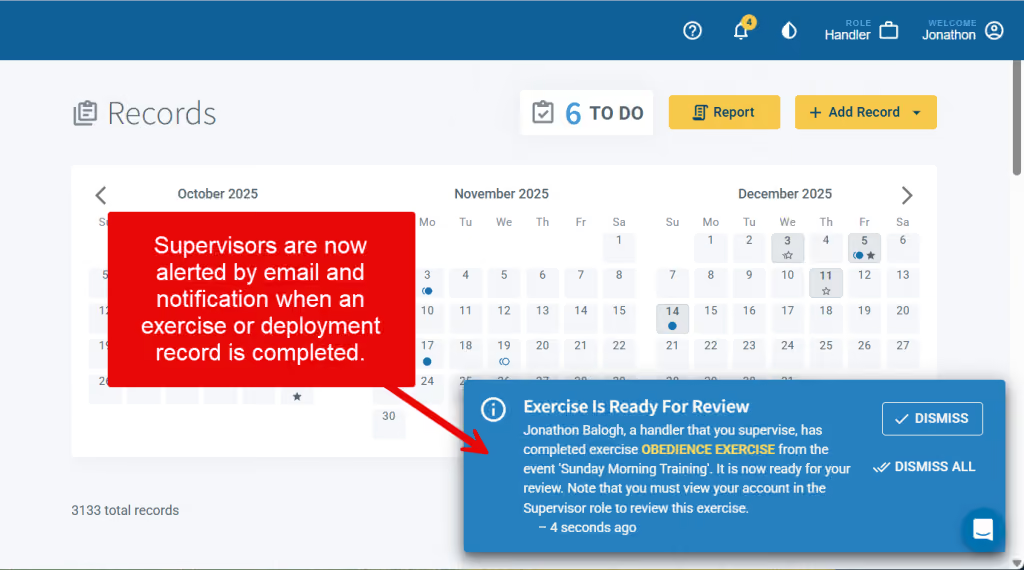
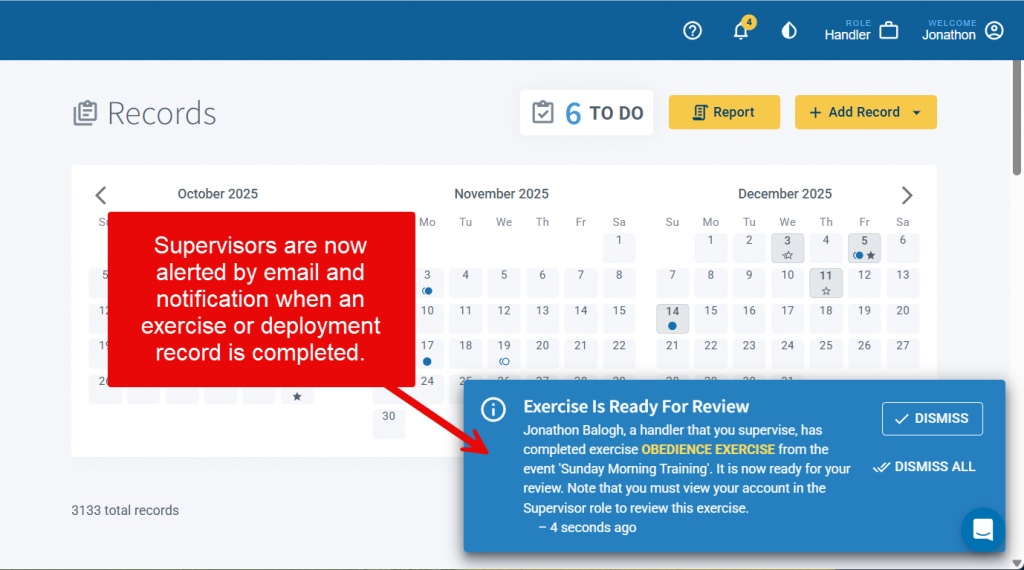
Supervisors can now choose to receive notifications whenever a handler they oversee completes a training or deployment record. This gives them a heads-up to review the new records. Notifications are sent by email as well as within PACKTRACK, keeping supervisors informed without requiring constant manual review. Supervisors can configure their preferences in the Notifications section of their Profile page, choosing whether to receive training record completion alerts, deployment record completion alerts or both. Note that these alerts are off by default. This feature enhances accountability and ensures important activity never gets overlooked.
Cleaner, More Modern Email Styling
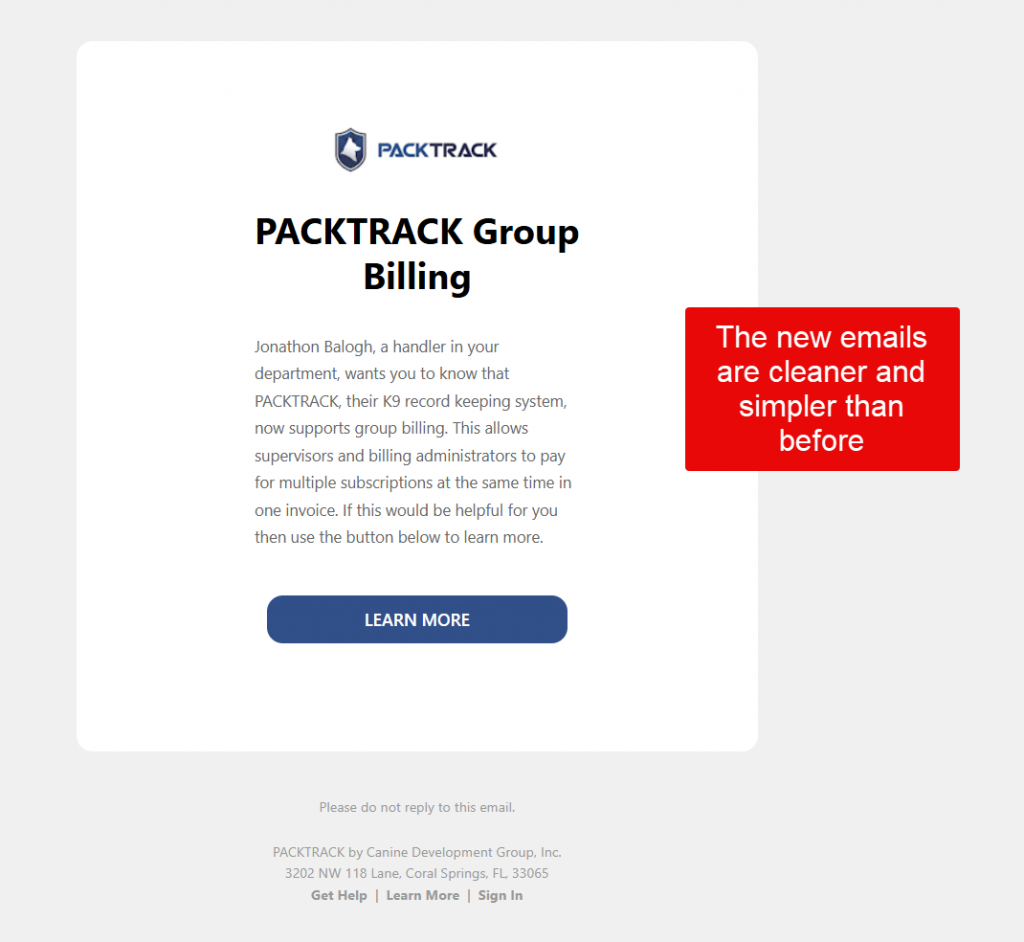
PACKTRACK emails just got a major upgrade. All system emails are now sent using clean, modern looking HTML formatting — with improved colors, visual hierarchy, and clear action buttons. These updates make PACKTRACK emails easier to read and quicker to act on, whether you're on your phone or desktop.
Share the News About Group Billing
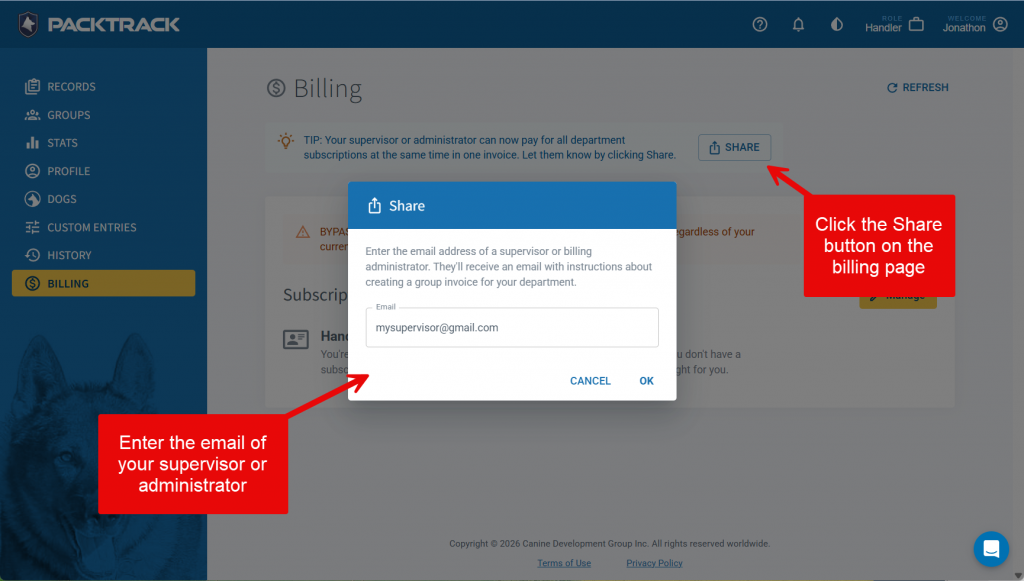
As of a couple months ago, your supervisor or administrator can use the new Group Billing feature to pay for all department subscriptions at the same time in one invoice. We now make it easy to share this feature with others. Visit your Billing page, click the Share button and then enter the email address of anyone in your department that should know about this. They'll get an email with a link to our Group Billing help article.
These features are part of our ongoing effort to make PACKTRACK the most intuitive K9 record-keeping platform available. As always, we welcome your feedback and look forward to sharing even more updates soon. If you haven’t explored these new features yet, log in and give them a try!
System Update
0
min read
Group Subscriptions
Managing multiple K9 handler subscriptions just got a whole lot easier. We’re excited to announce our newest feature - Group Subscriptions - designed to give department billing managers complete control over their team’s subscriptions, all under a single account.
Managing multiple K9 handler subscriptions just got a whole lot easier. We’re excited to announce our newest feature - Group Subscriptions - designed to give department billing managers complete control over their team’s subscriptions, all under a single account.
One Invoice, One Account, Total Control
With Group subscriptions, billing managers can now pay for and manage the subscriptions of multiple K9 handlers together. No more juggling individual invoices or tracking down renewals across separate accounts. Everything is streamlined into one centralized billing dashboard. Managing your team’s subscriptions is simple and flexible. First, invite the handlers in your department to join your group subscription. Next, purchase a license with the desired number of seats. That's it! If handlers join or leave the department, you can easily add, remove, or reassign seats at any time.
Why It Matters
For agencies with multiple K9 handlers, managing subscriptions individually can be time-consuming and confusing. Group subscriptions eliminates that friction, offering:
- Simplified billing – One invoice covers your entire team.
- Flexible management – Add or remove handlers as your team changes.
- Better oversight – Track your active users and seat usage in one place.
Step by Step Guide
Step 1: Get the Billing Manager role
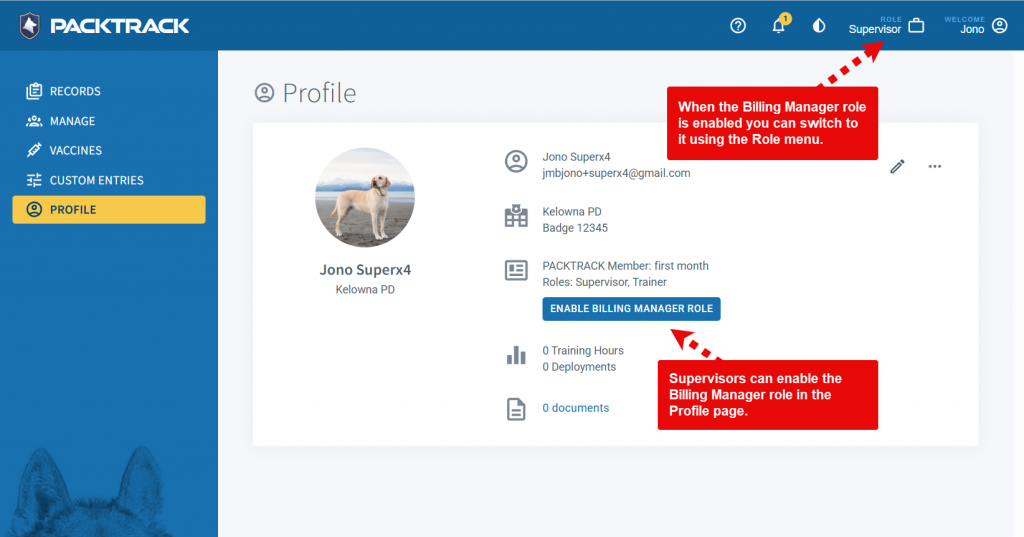
To access the group subscription feature you need to use the new Billing Manager role. A billing manager can be a handler, supervisor or administrator that's responsible for ensuring that everyone in the department has an up to date subscription. Only one person needs to do this for the department. You may select this role at
registration or, if you're currently a supervisor, then you can add the Billing Manager role from your Profile page. You may also ask for the role to be added to your account using our support chat.
Step 2: Choose handlers to be managed
Switch to the Billing Manager role and choose the Billing tab. Here, you'll add the handlers that you want to include in your group subscription. Note that your invitations are queued in the Pending list and will be sent later. The goal is simply to identify the handlers that you want to be covered.
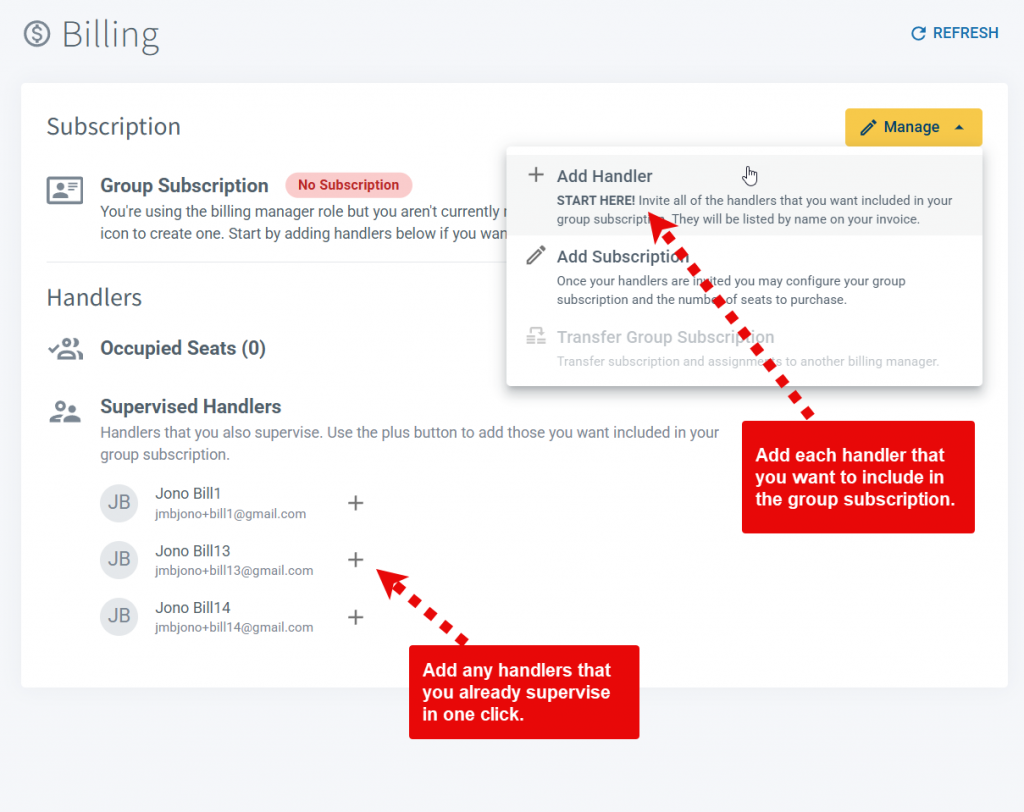
Use the Add Handler option in the Manage menu to provide the email address for each handler. If you already supervise handlers then they can be added by clicking the plus button next to their name in the Supervised Handlers list. If you add a handler that isn't a PACKTRACK member then they will receive an email asking them to sign up. This is a great way to onboard the handlers in your department with the PACKTRACK service. When they complete the registration they'll automatically be queued in the Pending list to be included in this group subscription.
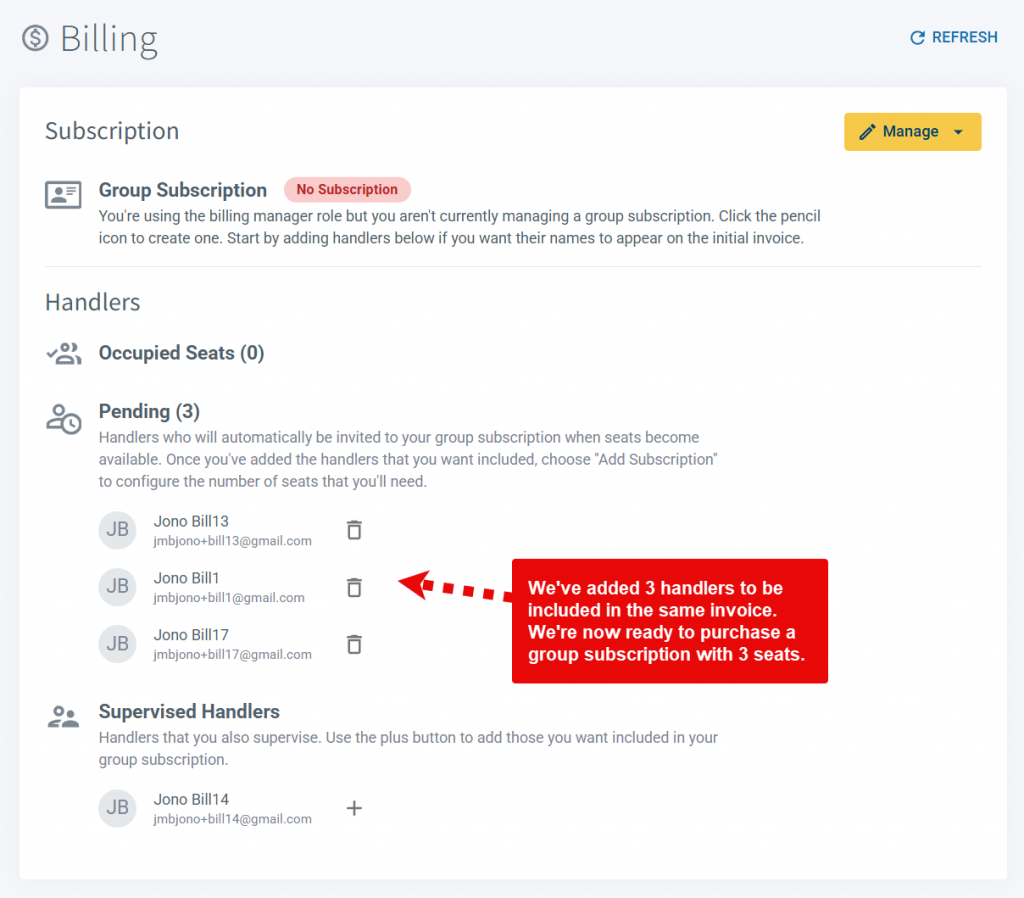
Step 3: Purchase a group subscription
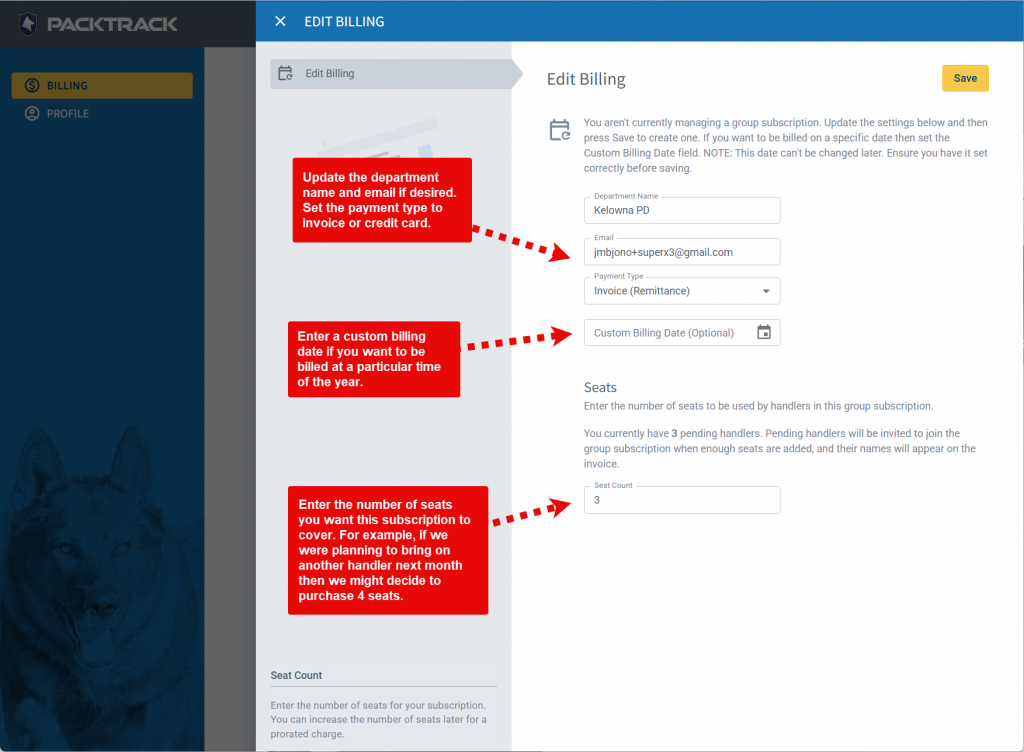
Now that you've identified the handlers that you want to include, you're ready to configure the group subscription. Click the Add Subscription option in the Manage drop down menu to open the billing editor. Adjust the department name and email address if desired, choose the desired payment type (invoice or credit card) and then enter the number of seats that you'd like to purchase. You also have the option of setting a specific billing date. If you want to be billed every year on January 1st then you'd enter that date here.
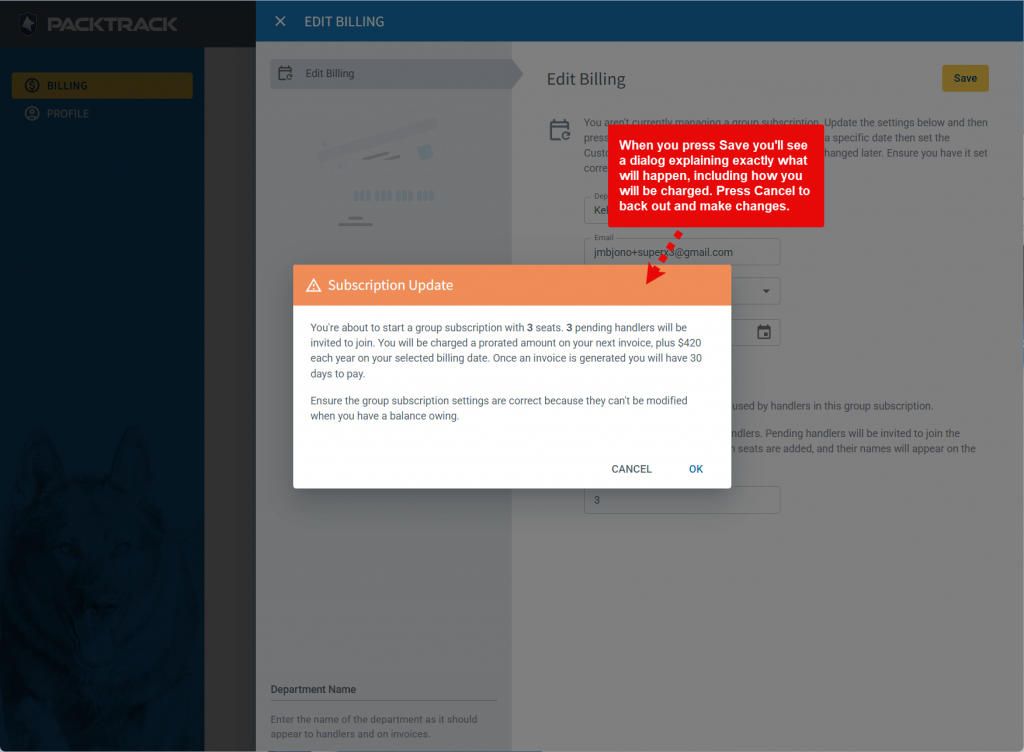
Once you purchase your subscription, the Billing page will update. Pending handlers will occupy the newly available seats and be invited to have their subscription paid for by the billing manager.
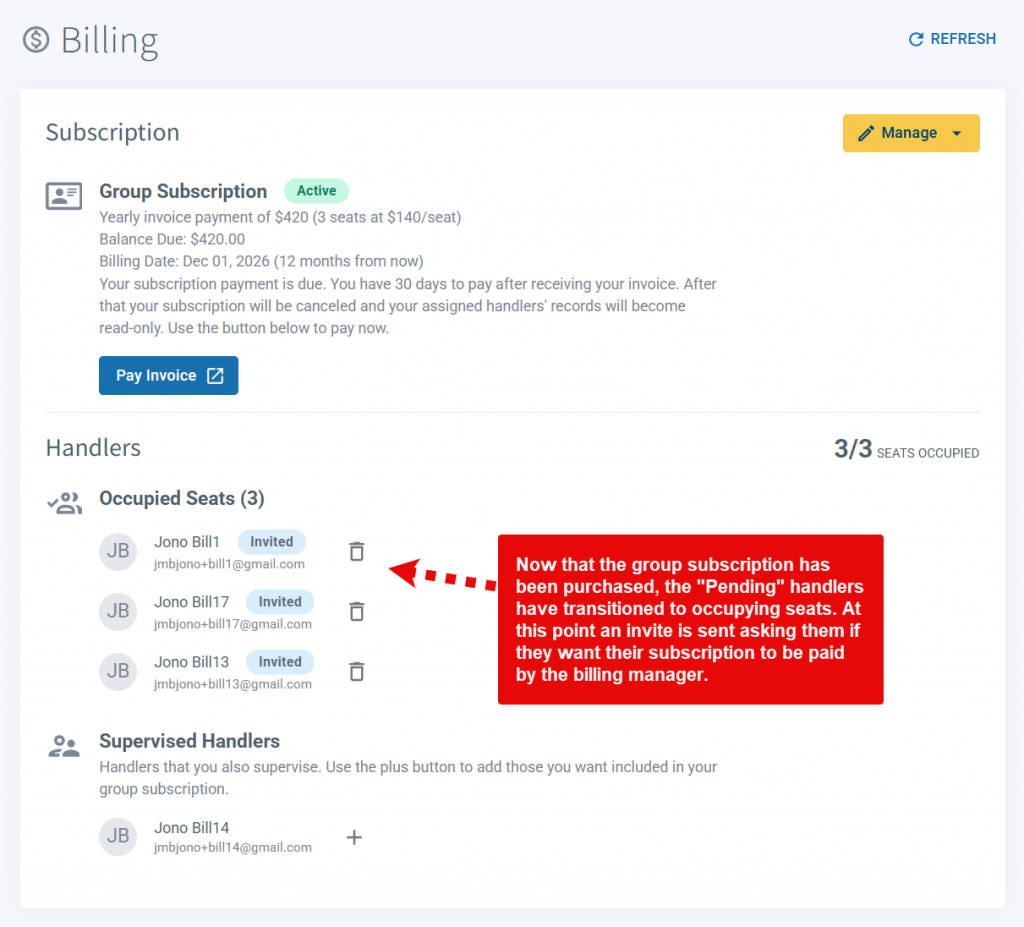
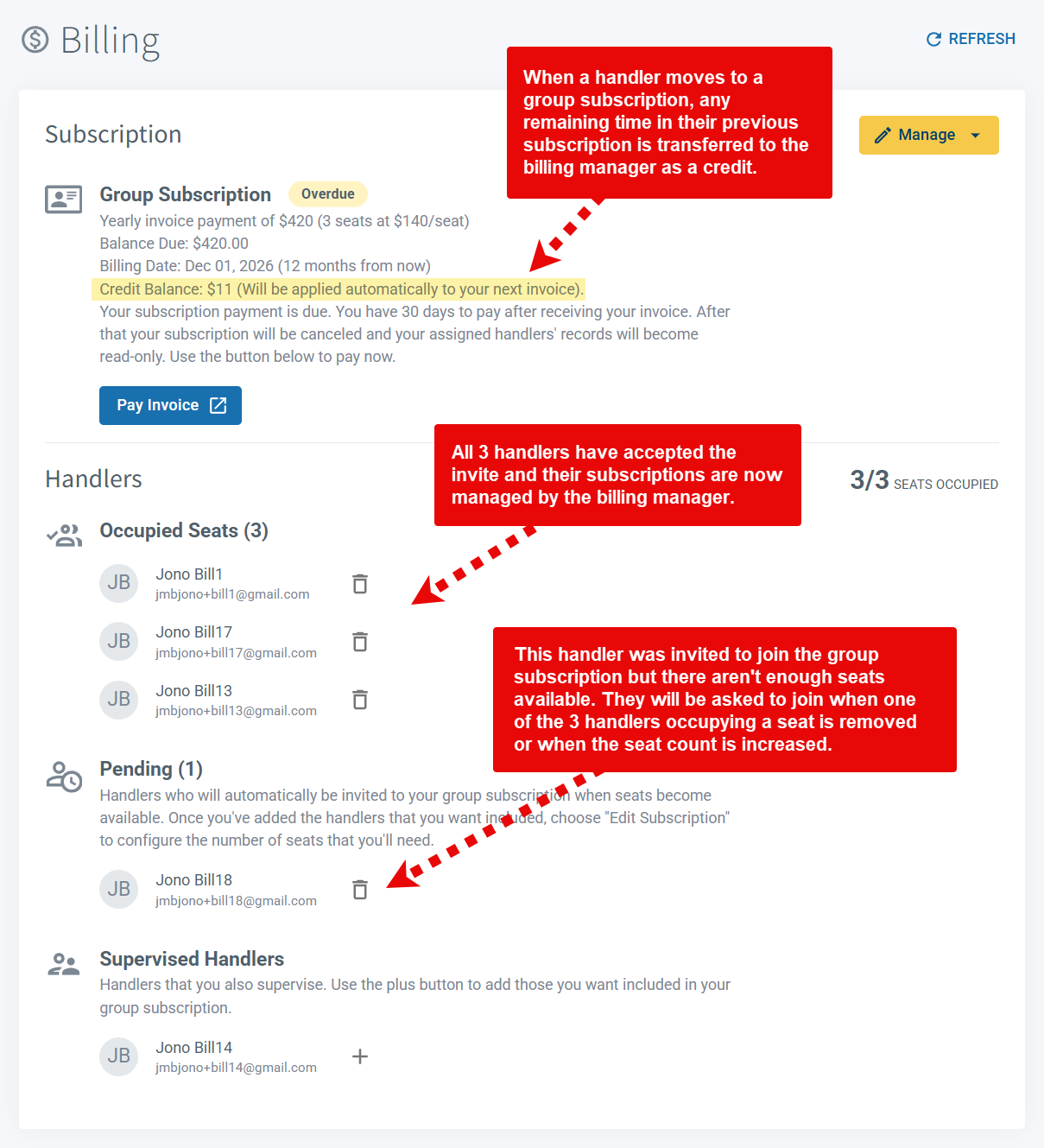
Handlers accept the invite and join the group subscription. Their previous subscription is cancelled. If there is paid time left on the handler's previous subscription then the unused portion will be credited to the billing manager's group subscription.
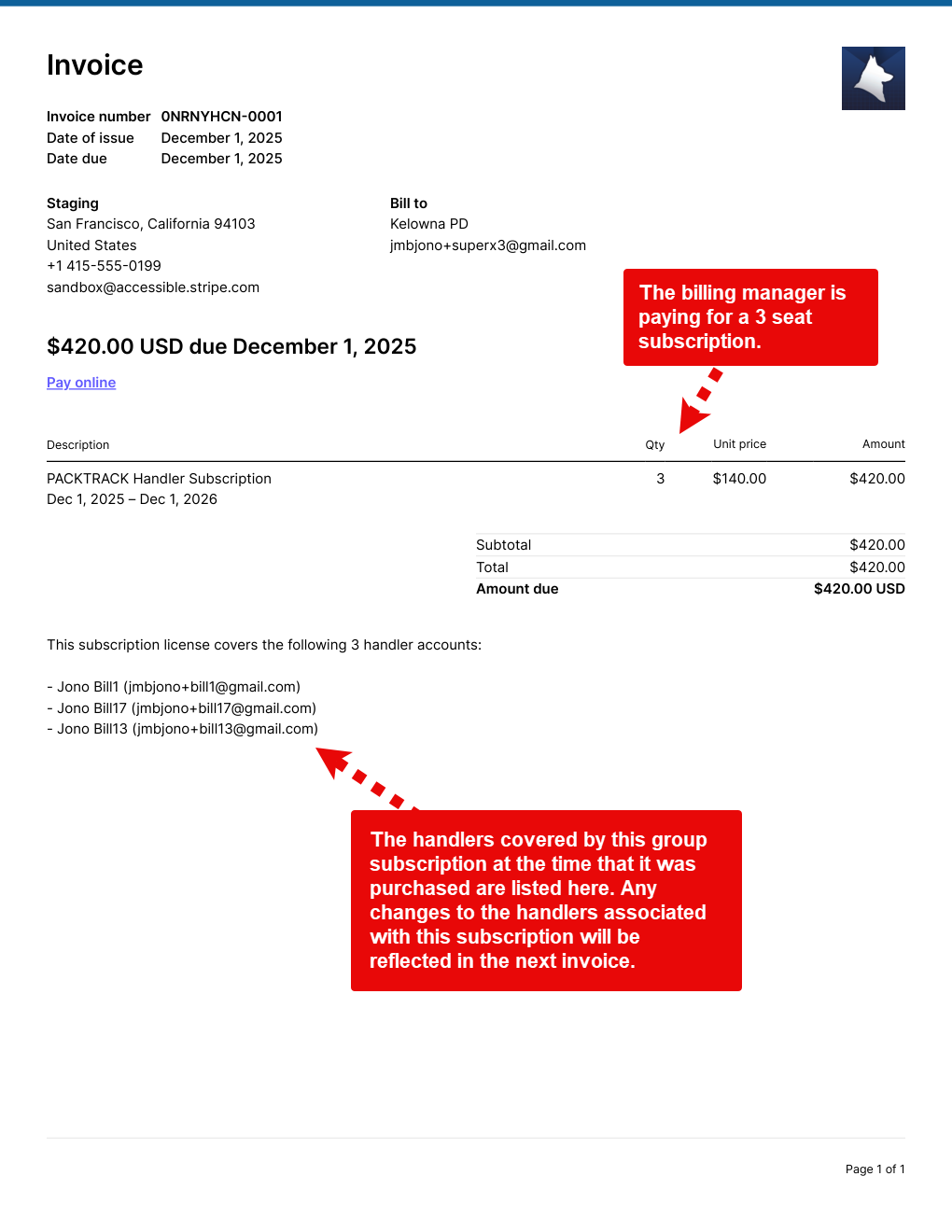
The billing manager receives an invoice based on the number of purchased seats. All handlers who occupy seats are listed on the invoice. This reflects the handlers assigned to this group subscription at the time that it was created. Future changes to the list of handlers will be shown on the invoice which is due at your next billing date.
Step 4: Make changes later
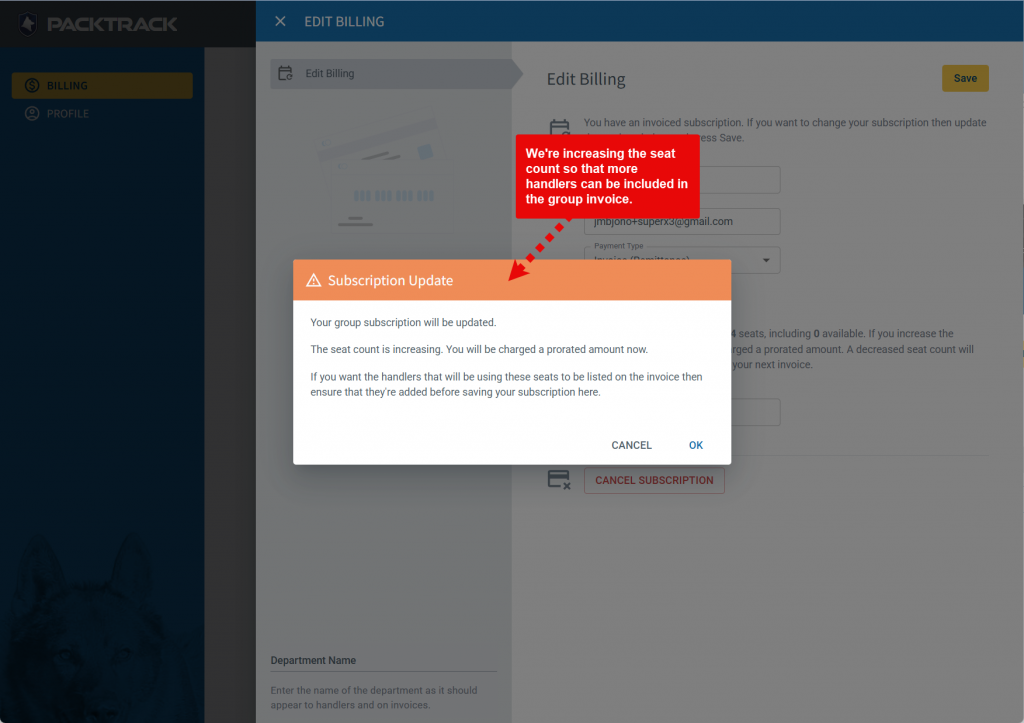
What happens if things change? Perhaps you need to swap out one handler for another or add/remove seats before the next billing date. You can remove assigned handlers using the trash can icon next to their names. Add new ones using the Add Handler option in the Manage drop down menu or select them from the Supervised Handlers list. If you need to adjust the seat count then use the Edit Subscription option in the Manage drop down menu and adjust the Seat Count field up or down. Increasing the count will result in a prorated charge based on the amount of time remaining in your subscription. Decreasing the count will lower the subscription cost shown on your next yearly invoice.
Group subscriptions are all about making life easier for K9 teams and their departments — freeing up more time for what really matters: supporting the dogs and handlers who keep our communities safe. We encourage departments of all sizes to use the group subscription feature to simplify billing. Consider forwarding this page to your department administrator to let them know about this feature. We're constantly updating and improving the PACKTRACK experience and we'd love to hear your feedback.
System Update
0
min read
Single Sign-On Is Here!
The new Sign in with Microsoft feature provides a simple and secure way to sign into PACKTRACK using your Microsoft work account. Note that this feature won't work if you try to sign in using a personal Microsoft account. Instead, select this login option if your department uses single sign-on (SSO) through Microsoft Entra ID (formerly Active Directory). Once configured, you'll be able to login to PACKTRACK using your department email address. This makes logging in easier but it also increases security. This feature works in both the web browser and in the PACKTRACK app (v5.2.0 or above). You must have an active PACKTRACK account. Note that if your department uses SAML technology for single sign-on then that isn't yet supported. Reach out to your IT department to confirm this feature is right for you. They can help you get set up.
The new Sign in with Microsoft feature provides a simple and secure way to sign into PACKTRACK using your Microsoft work account. Note that this feature won't work if you try to sign in using a personal Microsoft account. Instead, select this login option if your department uses single sign-on (SSO) through Microsoft Entra ID (formerly Active Directory). Once configured, you'll be able to login to PACKTRACK using your department email address. This makes logging in easier but it also increases security. This feature works in both the web browser and in the PACKTRACK app (v5.2.0 or above). You must have an active PACKTRACK account. Note that if your department uses SAML technology for single sign-on then that isn't yet supported. Reach out to your IT department to confirm this feature is right for you. They can help you get set up.
Connect Your Microsoft Account
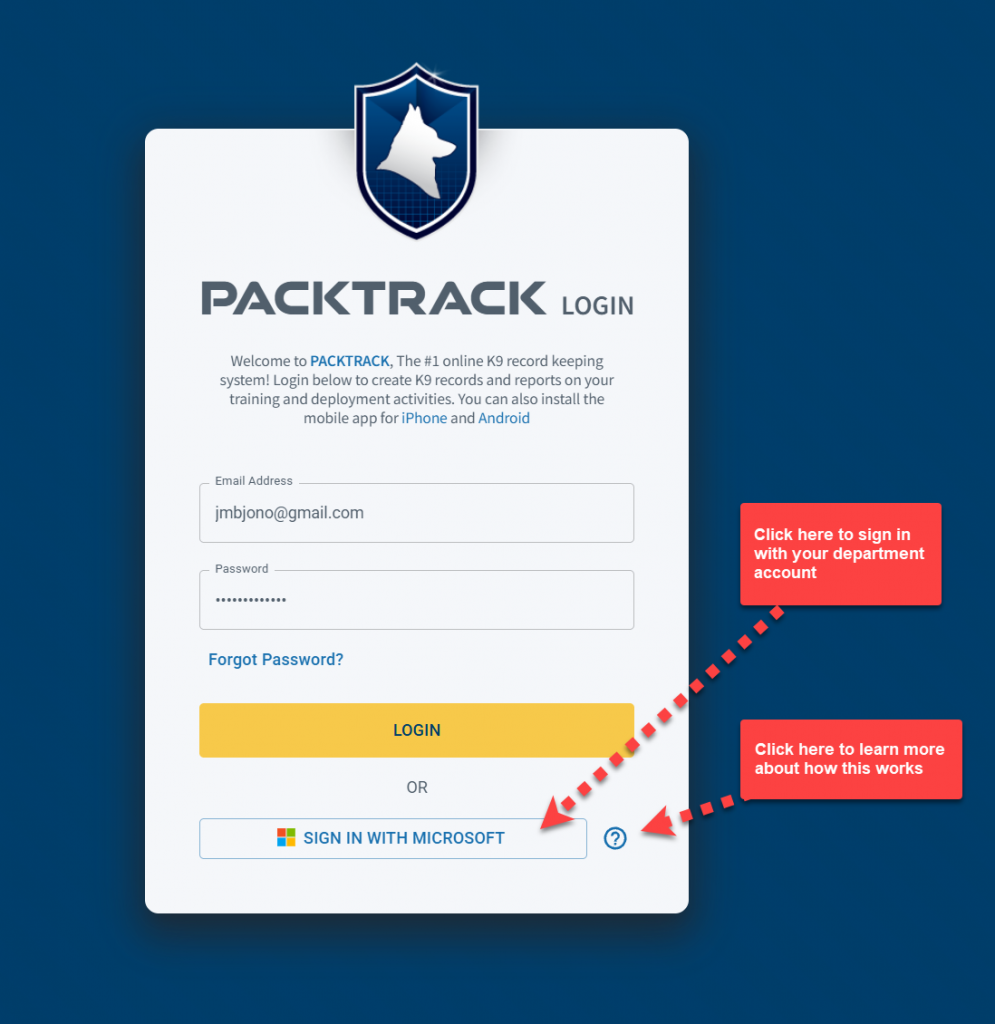
1. Click the Sign in with Microsoft button.
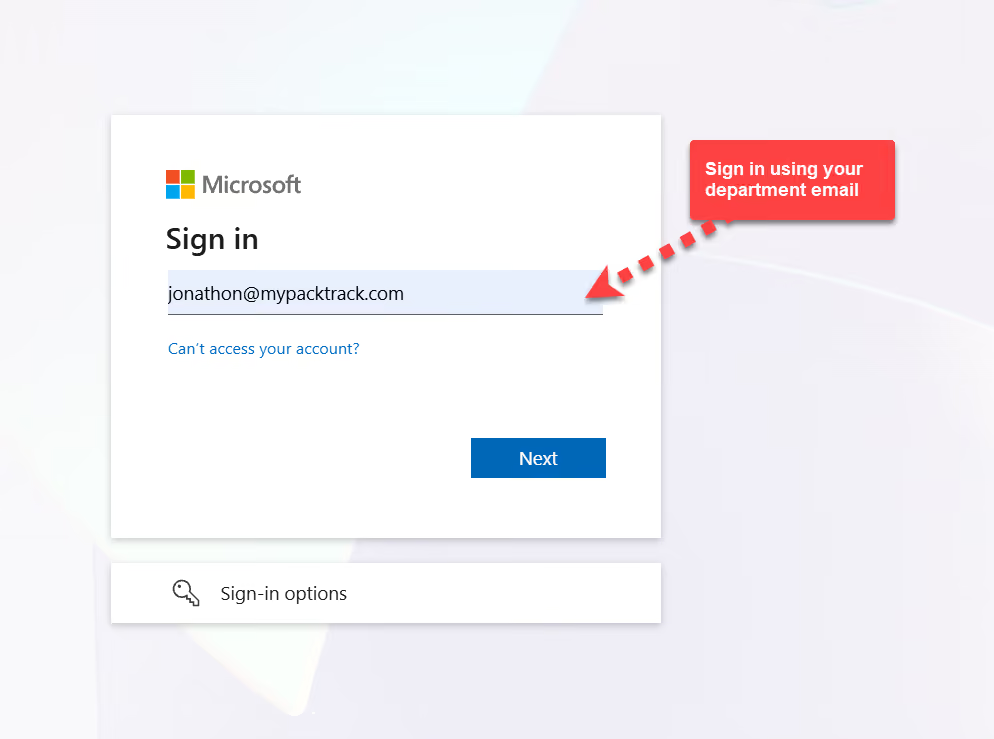
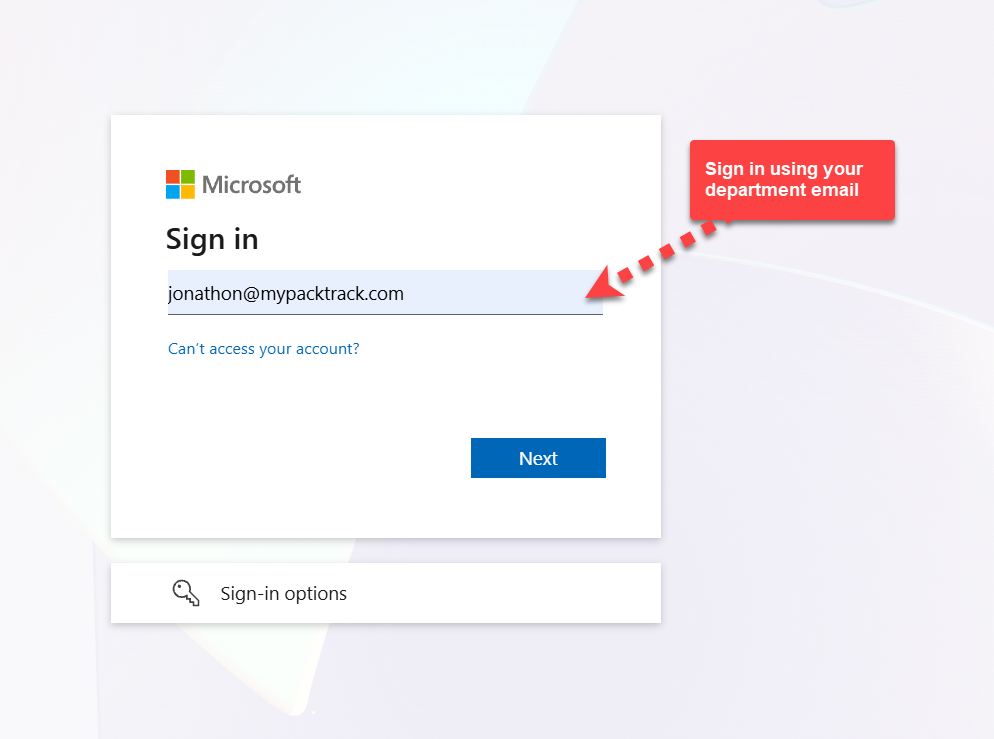
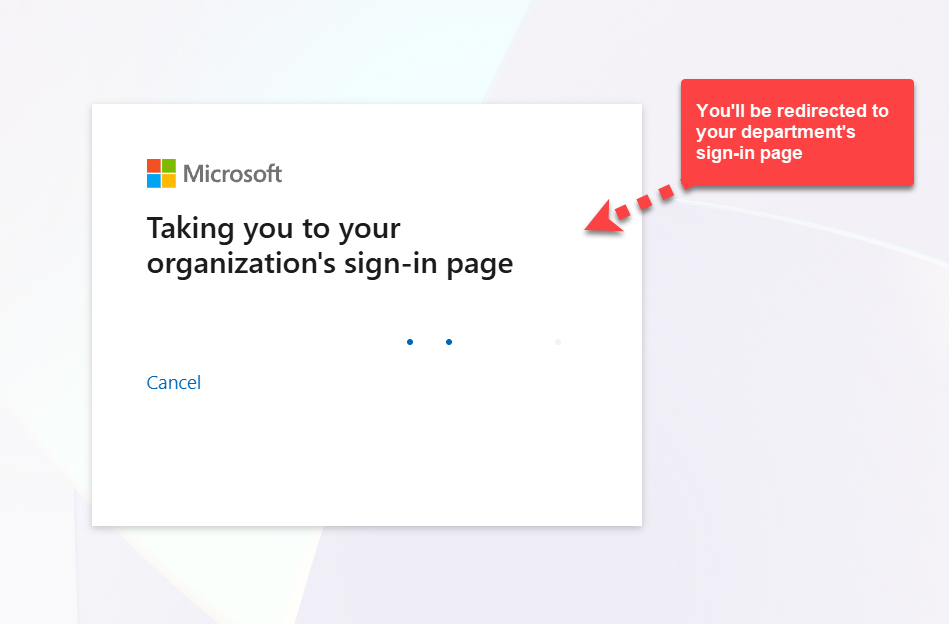
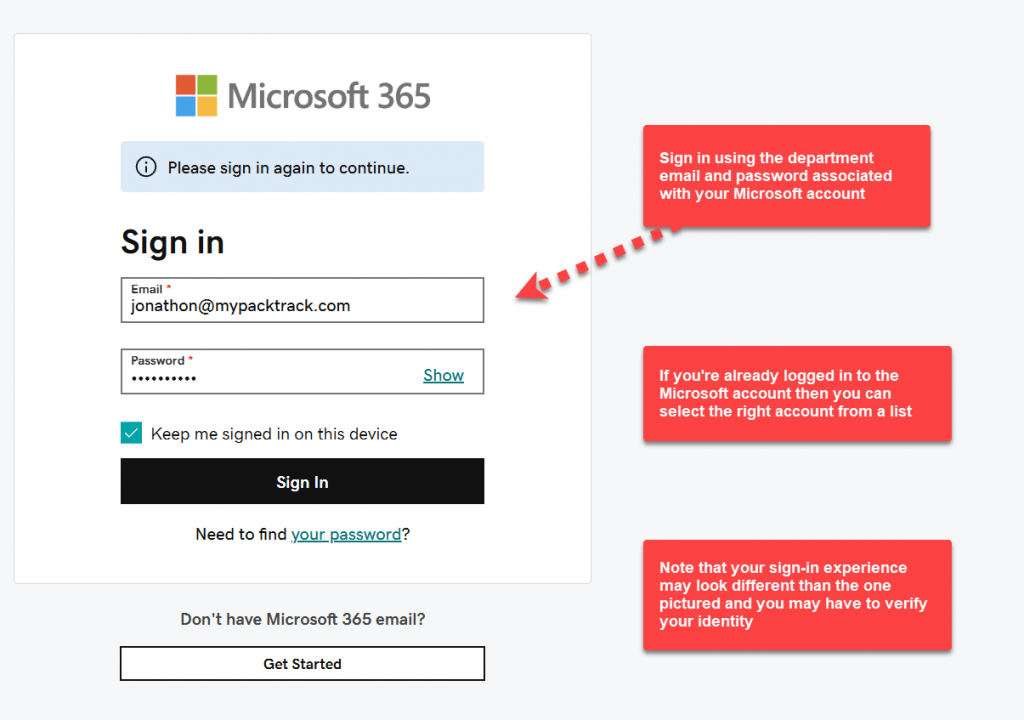
2. Enter your department email and then wait to get redirected to your department login. Once there, type in the department email address and password associated with your Microsoft account or select it from the list. You may also have to verify yourself using 2 factor authentication.
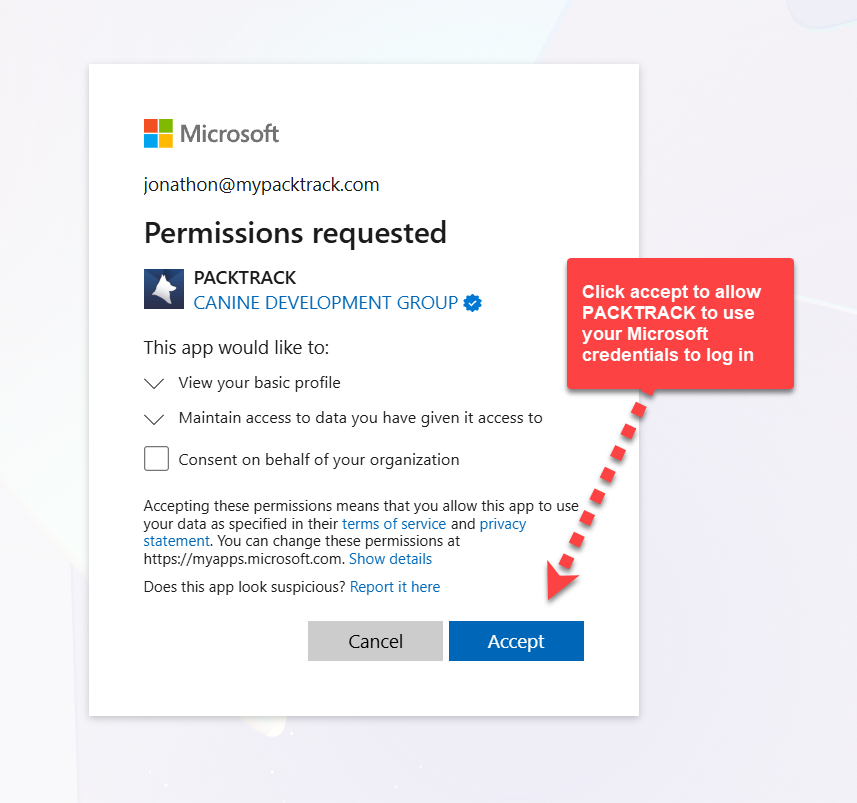
3. Click Accept on the permission screen to allow PACKTRACK to use your Microsoft account credentials to log in.
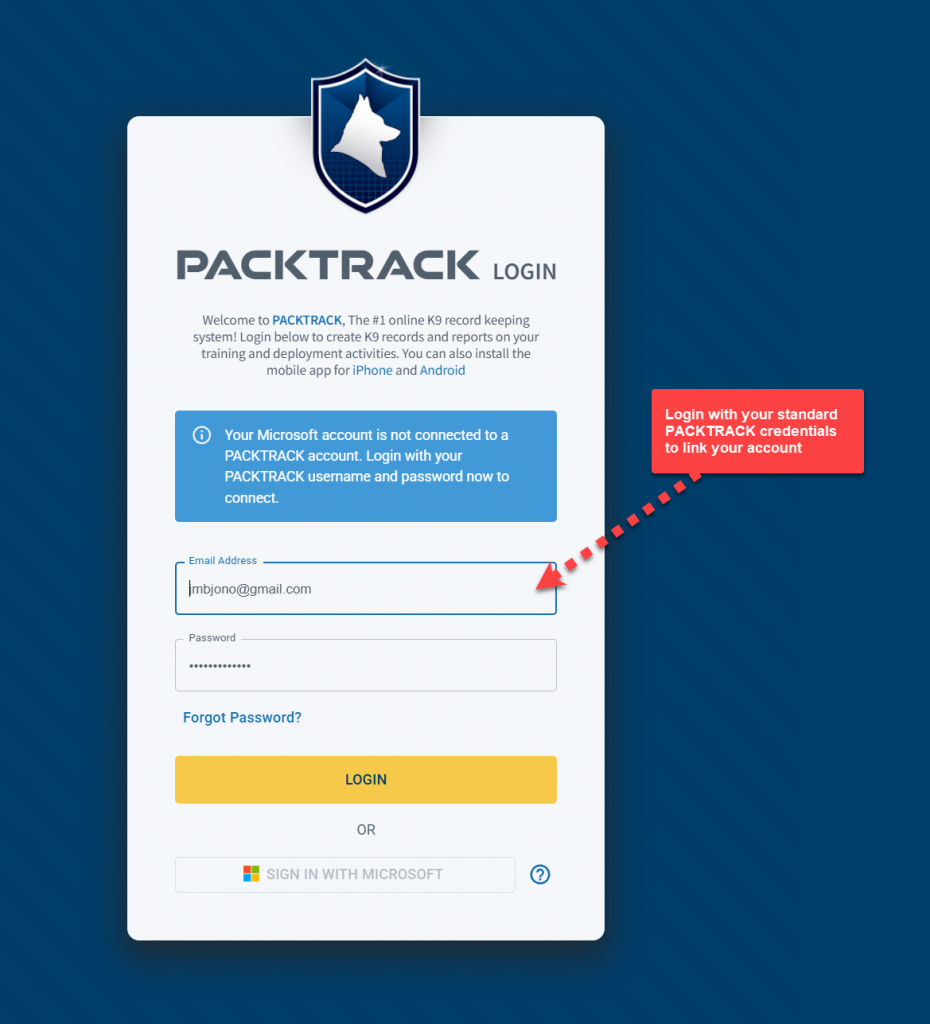
4. You should now be back at the login page and see a note asking you to link your PACKTRACK account. If you don't see this then try reloading the page. Type in your PACKTRACK email address and password.
5. You're all set. The next time you press the Sign in with Microsoft button you'll just need to enter your department credentials. As an alternative, you can also configure Single Sign-On after you're logged in. Simply visit the Microsoft Account option in your Profile page and click the Connect Microsoft Account button.
Disconnect Your Microsoft Account
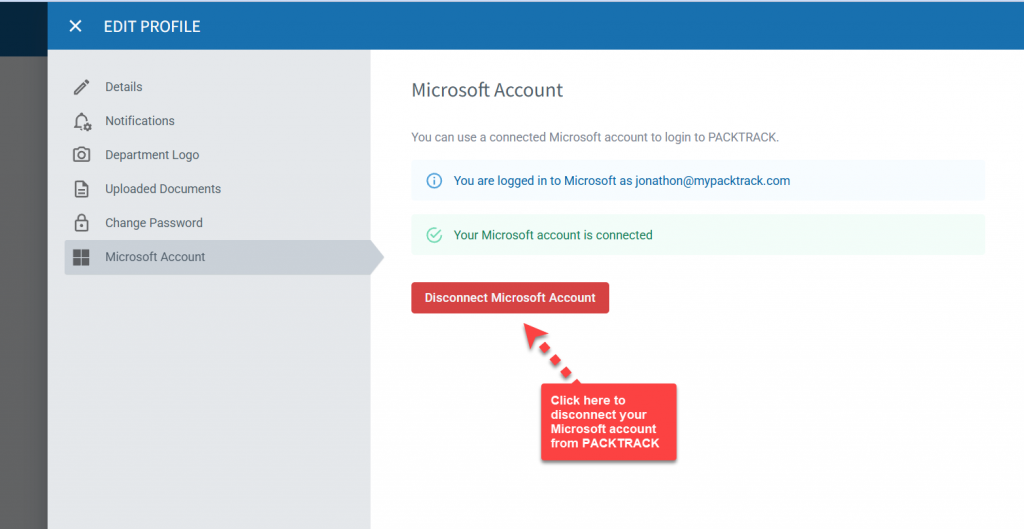
If you connected the wrong account or just want to remove your Microsoft account from PACKTRACK then use the disconnect option. Click the Profile link in the main menu then select the Microsoft Account option. This will open the editor as shown below. Click the Disconnect Microsoft Account button.
Technical Note (For Entra ID administrators only)
In some situations it may be desirable to approve the PACKTRACK app for SSO across all users of your department. This can be especially helpful if there are restrictions on who can add service principals to your Entra ID configuration. Admins that are authorized to consent on behalf of the department can use
THIS LINK to grant tenant-wide admin consent to the PACKTRACK application. Learn More about how this works. When this is complete, the PACKTRACK service principal is added to your Enterprise Applications list in Entra ID. This allows all department users to access the application without explicitly providing consent. Note, however, that they must still link their department credentials to PACKTRACK the first time that they use SSO.
System Update
0
min read
Make PACKTRACK Your Own with Custom Entries
Managing K9 records requires accuracy and consistency. We know how frustrating it can be when small mistakes, like a typo in a dropdown option or duplicate entries, create confusion in your reports. That’s why we’re excited to share some big changes to the Custom Entries page.
Improved Custom Entry Editing
Managing K9 records requires accuracy and consistency. We know how frustrating it can be when small mistakes, like a typo in a dropdown option or duplicate entries, create confusion in your reports. That’s why we’re excited to share some big changes to the Custom Entries page.
What Are Custom Entries?
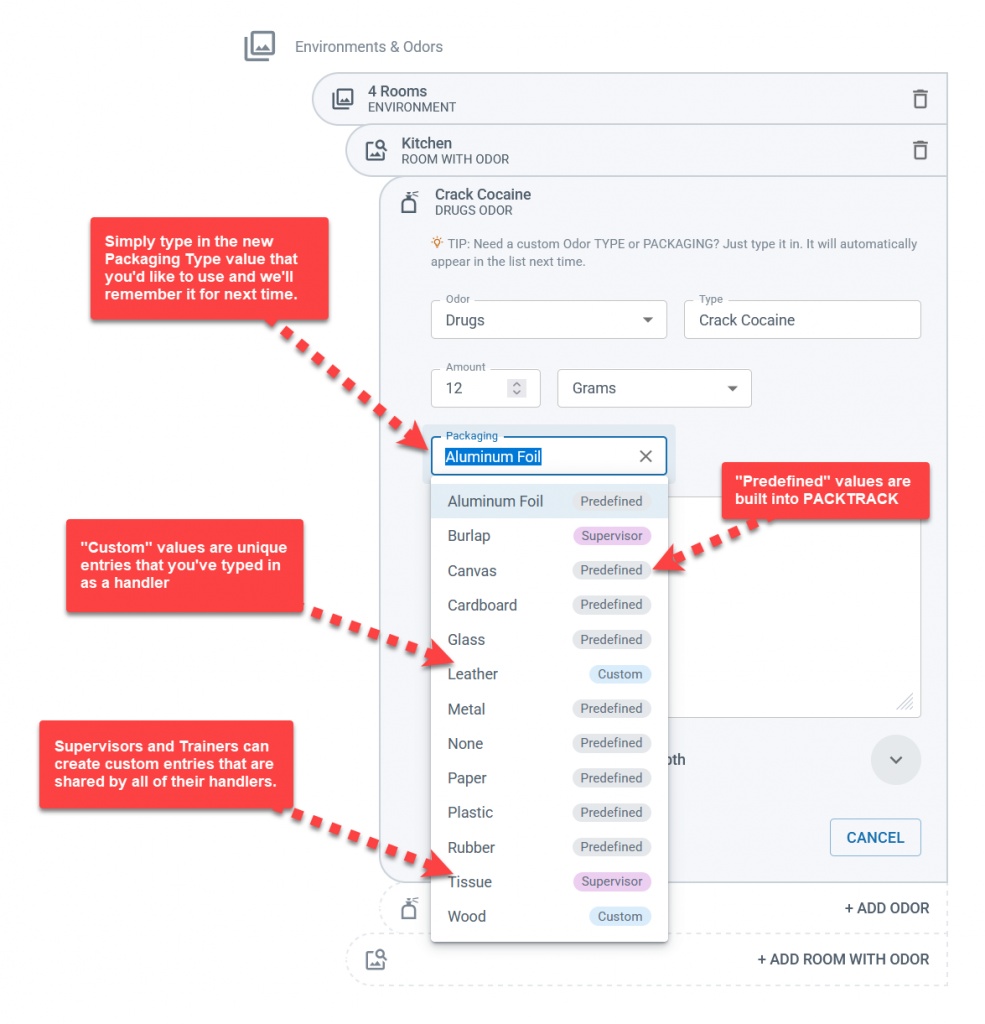
PACKTRACK is flexible. In most cases, if you don't find an option that you're looking for in a dropdown then you can just add your own. For example, you might want to specify that your detection odor was packaged in cloth. We provide several predefined options for packaging types but that one isn't listed. Simply type in the new value instead of choosing an existing option and we'll store that as a new packaging type for you to use next time. We call these unique values "custom entries". You can customize odors, packaging, event and deployment tags, requesting units and weather.
Why Would You Need To Edit Them?
If you can type a custom value whenever you need it then why would you need the Custom Entries page? You might not! However, if you add a lot of values or belong to a department where these values are standardized then this page gives you the flexibility to keep things organized. There are a few reasons you might want to edit your custom entries:
- Fix spelling mistakes and improve wording
- Merge values that are similar or standardized
- Delete values that are no longer used in your records
What's In The Custom Entries Page?
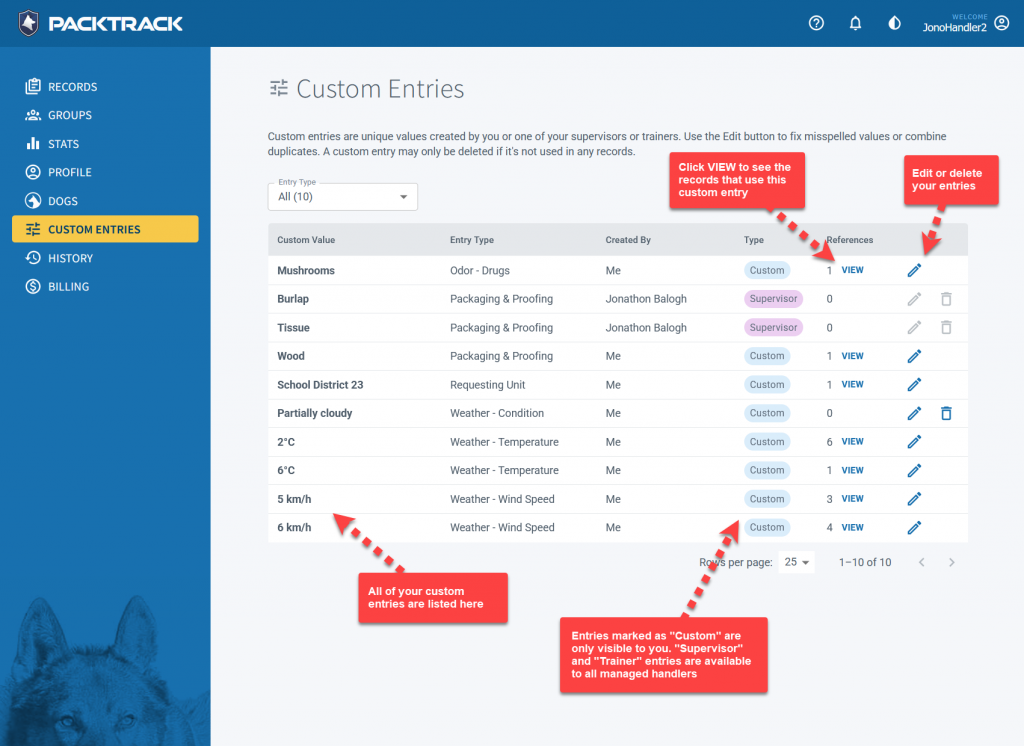
The Custom Entries page provides an overview of all of the values that you've added to PACKTRACK. If you have a lot then you can filter by custom entry type using the dropdown at the top of the page. Added values are shown in a grid. Each row shows the value, the entry type, who made the entry and the number of references to this entry in your records. Click the VIEW link to open the Records page. It will be filtered to show the records containing this entry.
How Do You Edit Your Custom Entries?
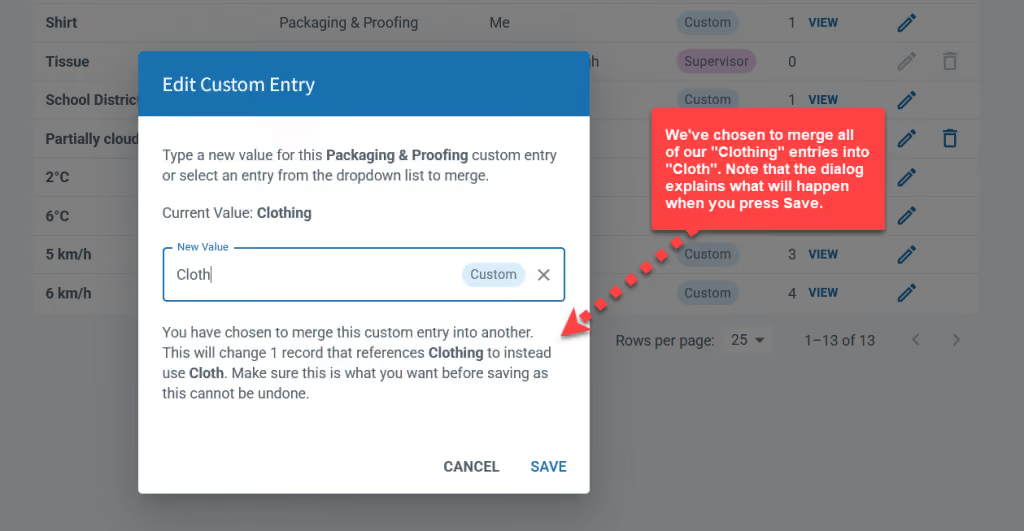
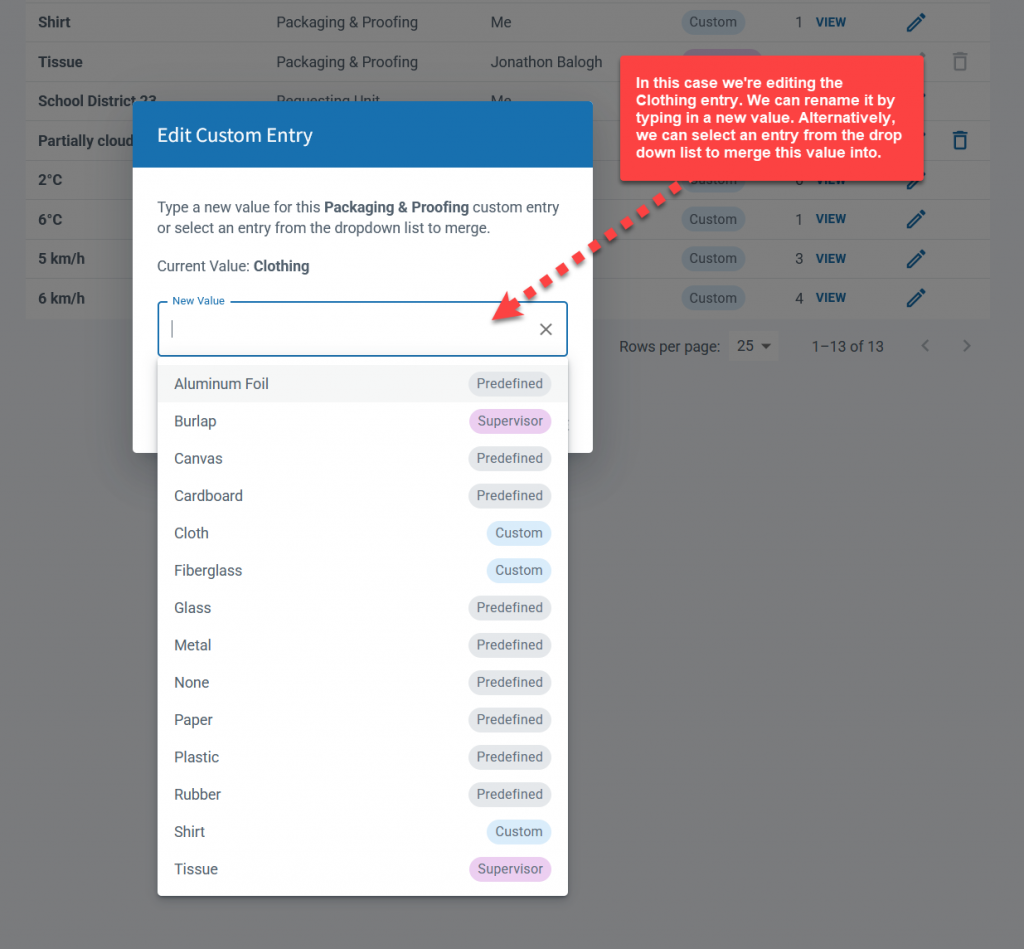
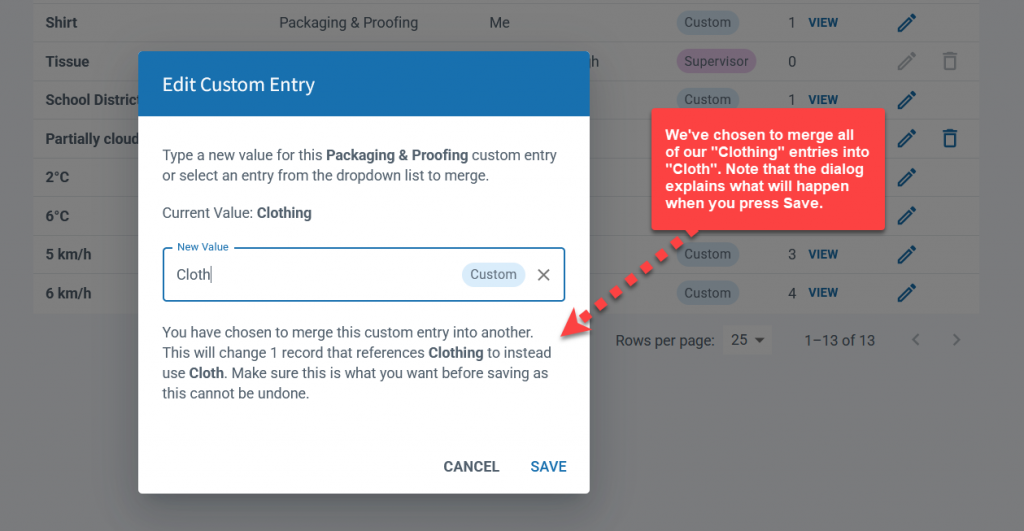
Each row in the grid includes an edit button. Click this to make changes. The displayed dialog will walk you through your edit. To replace your current value with an existing value, simply choose one from the dropdown list. To rename the current value, type it in. Note that the dialog will explain exactly what happens if you save your changes. If the entry is no longer used anywhere in your records then the row in the table will also show a delete option.
How Do Supervisors And Trainers Use This Feature?
Custom entry editing is also available to supervisors and trainers. These roles can view the custom entries for all handlers that they manage. There are a couple reasons they might want to make changes:
- Correct handler mistakes or inconsistencies
- Enforce standard terms within the department
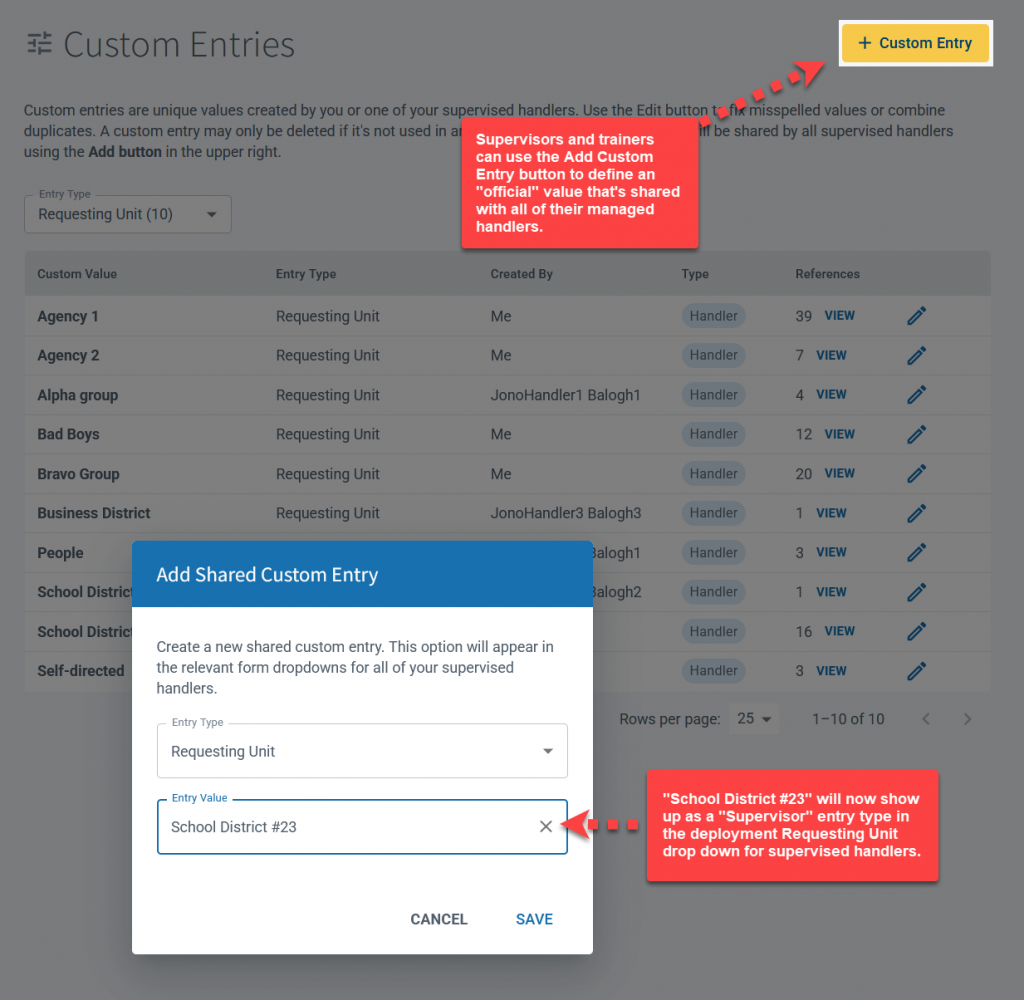
Supervisors and trainers can edit entries just like handlers. If one of their handlers misspells a word, for example, then they can easily fix it. These roles can also ensure that the same terminology is used by everyone in the department. This keeps their reports clean and eliminates duplication. Rather than manually fix every custom entry, supervisors and trainers are encouraged to define their own official values for their handlers to use. For example, a supervisor may notice that the deployment requesting unit for "School District 23" is recorded differently by each handler. Handlers within the department might label this as "District 23", "school" or "Education district". The supervisor can use the Add Custom Entry button to define a "Supervisor" entry for requesting units in their department. This creates a standardized entry value that will appear in the Requesting Unit/Agency dropdown for all handlers in that department. It's best to define these official entry values ahead of time to create a standardized list of department terms.
Why This Matters
Accurate records are essential for training documentation, court reporting, and departmental review. Even small inconsistencies can slow down reporting or create confusion across teams. By giving you control to edit and streamline your custom entries, we’re making it easier to maintain reliable, professional records. Custom entry editing is another step toward giving you more flexibility and control over your K9 records. We’re committed to making your record keeping system as reliable and user-friendly as possible so you can focus on what matters most - your work with your K9 partners.
System Update
0
min read
K9 Not Deployed? Record It Anyway.
We're constantly working behind the scenes to enhance your PACKTRACK experience. In addition to major releases, we regularly roll out smaller updates to refine performance, fix bugs, and make your daily workflow more efficient. The latest improvements bring a few new features worth highlighting.
We're constantly working behind the scenes to enhance your PACKTRACK experience. In addition to major releases, we regularly roll out smaller updates to refine performance, fix bugs, and make your daily workflow more efficient. The latest improvements bring a few new features worth highlighting.
Recording when your K9 isn't deployed
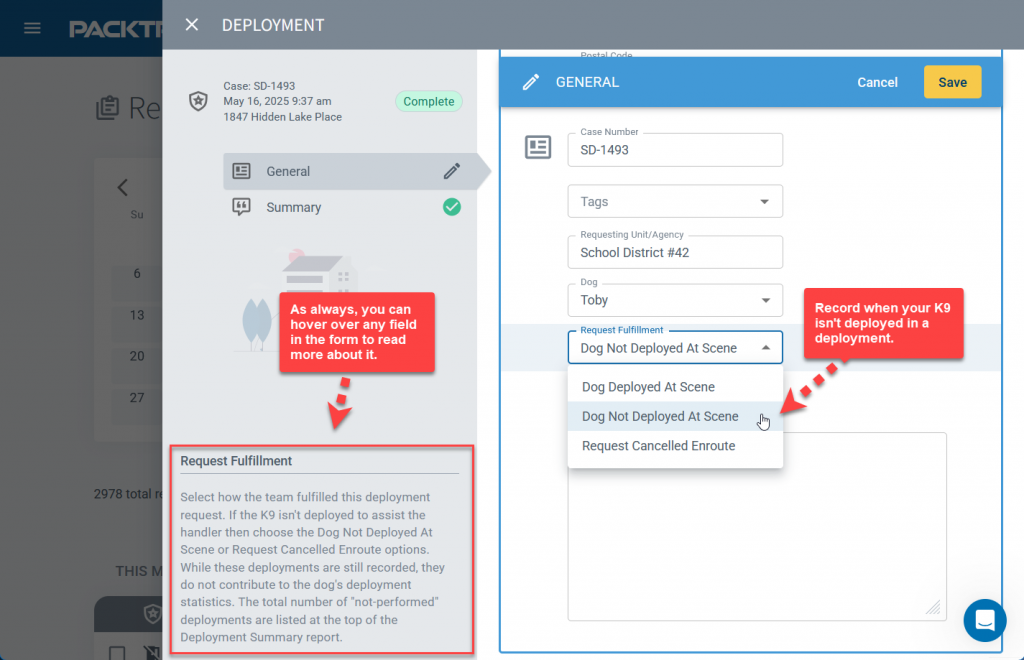
You've always been able to log K9 deployments in PACKTRACK — but what about when your dog isn't used? Maybe the deployment was canceled enroute or the situation at the scene made it unsafe to deploy your K9. You can now record these events and mark them with a specific Request Fulfillment status: Dog Deployed at Scene, Dog Not Deployed at Scene or Request Cancelled Enroute. Choosing either of the last two options hides the rest of the deployment form but you can still enter comments to explain what happened.
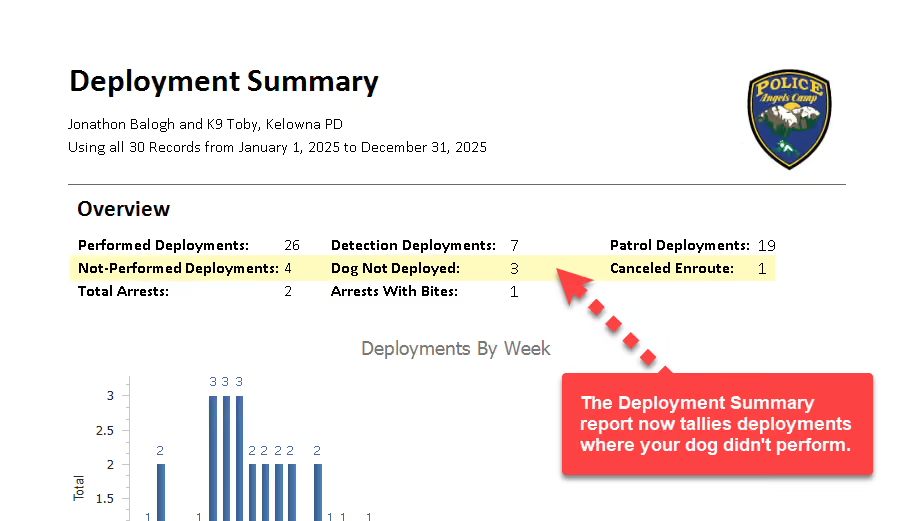
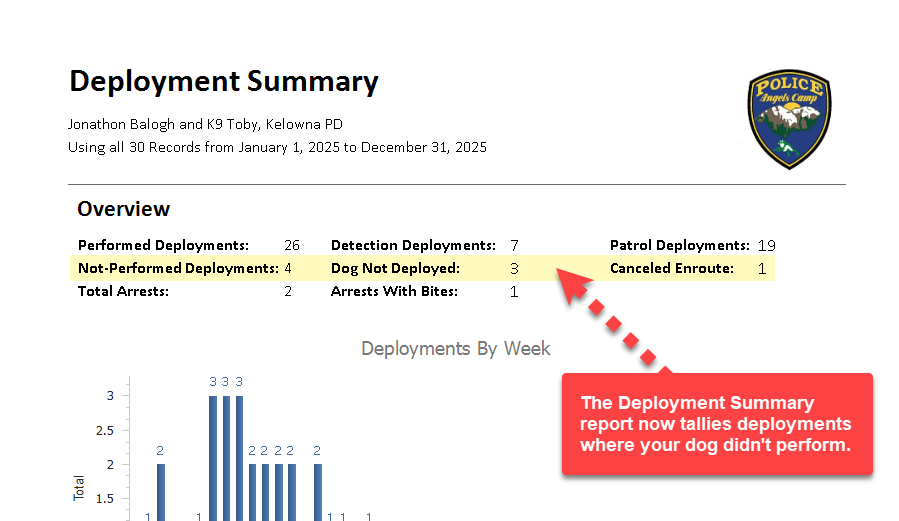
These entries don't count as full K9 deployments in your statistics but they're still tracked and visible on your Records page and can be printed as standalone reports. While the deployments aren't directly included in the Deployment Log and Deployment Summary reports, you will be able to see the number of times your K9 wasn't deployed at the top of the Deployment Summary report.
Demographic report data
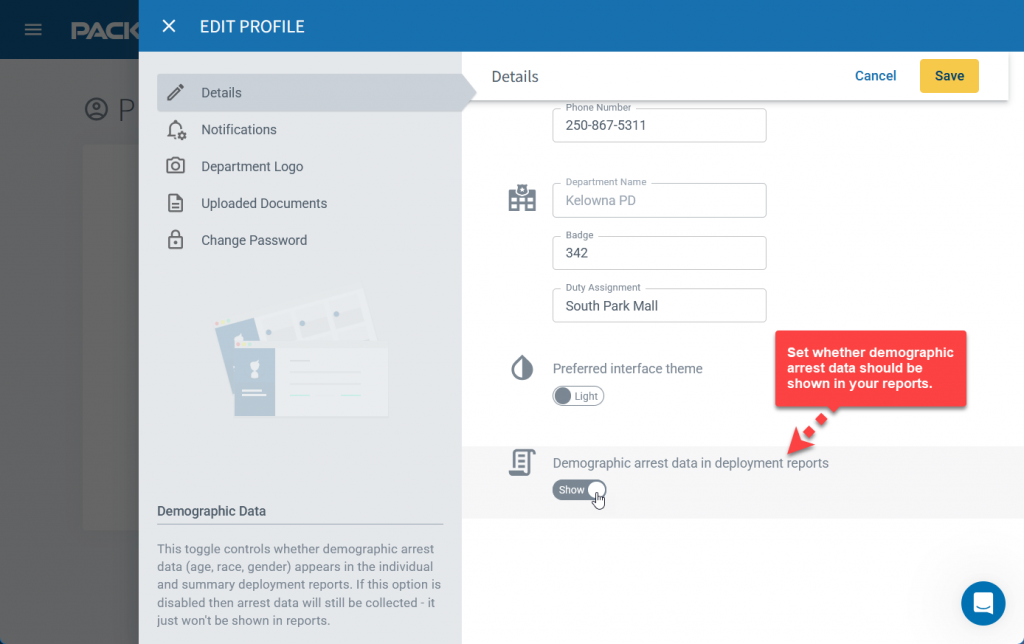
Recording demographic data is required for all deployment arrests. With this update, however, you can now choose whether to include the information in your individual and summary deployment reports. Change this setting using the new toggle switch in your profile page.
New login and password reset pages
We've redesigned the Login and Password Reset pages to provide a more consistent experience across all devices — including mobile. Best of all, you can now reset your password directly from your phone.
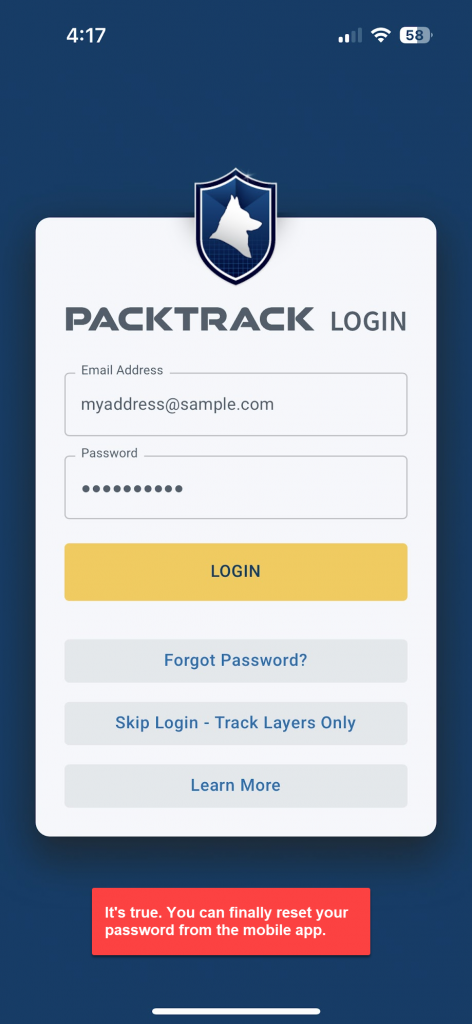
Thanks for using PACKTRACK! If you have any comments or feedback on these changes then please let us know.
System Update
0
min read
Deployment Heatmaps
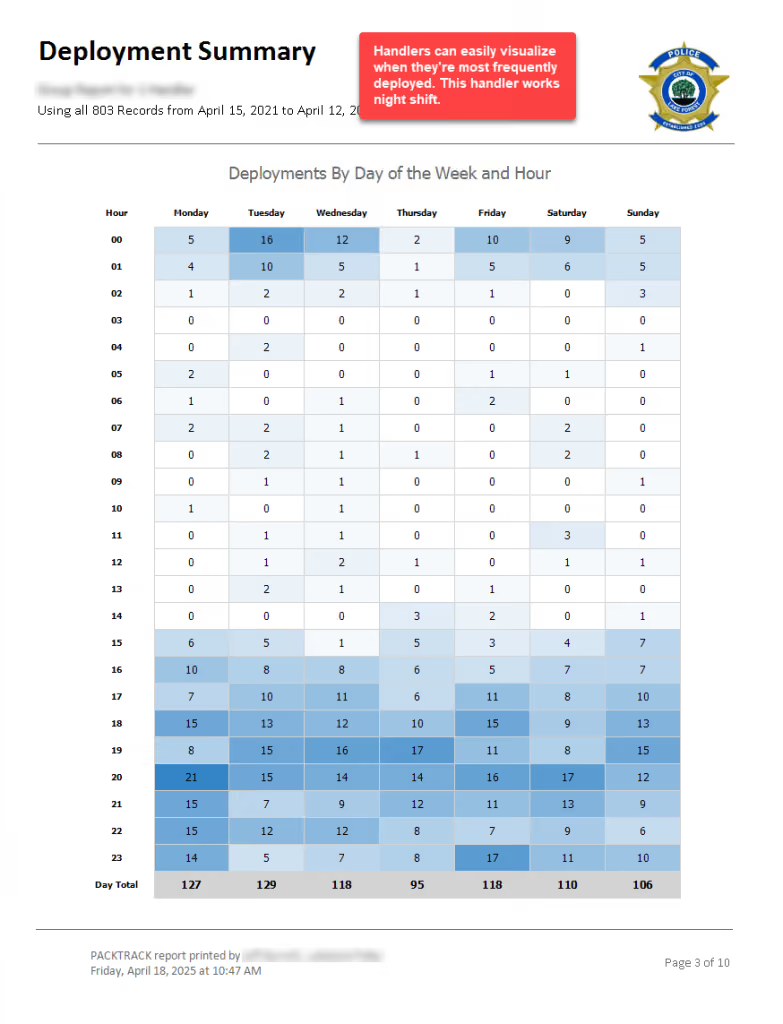
The PACKTRACK Deployment Summary report just got more insightful. A new table now highlights exactly when your K9 teams are being deployed using a visual breakdown of activity by day of the week and hour of the day. This gives you a clear, at-a-glance view of peak deployment times - making it easier than ever to spot patterns, optimize staffing, and share key activity insights with leadership. The goal is to help you make smarter, data-driven decisions to get even more value from the records you keep.
The PACKTRACK Deployment Summary report just got more insightful. A new table now highlights exactly when your K9 teams are being deployed using a visual breakdown of activity by day of the week and hour of the day. This gives you a clear, at-a-glance view of peak deployment times - making it easier than ever to spot patterns, optimize staffing, and share key activity insights with leadership. The goal is to help you make smarter, data-driven decisions to get even more value from the records you keep.
The Deployment Summary report is available for handlers and supervisors and provides great flexibility. It's easy to filter by dog, date range, deployment type, and more - so you can get the insights you need. For example, as a handler you may want to know when you're most frequently deployed for K9 tracking work. Simply filter your records for tracking deployments, hit the Report button and then select the Deployment Summary report. As a supervisor, you could be interested in when handlers are most frequently deployed for a specific requesting agency. To do this, filter your records by the desired requesting agency and then run the Deployment Summary report.
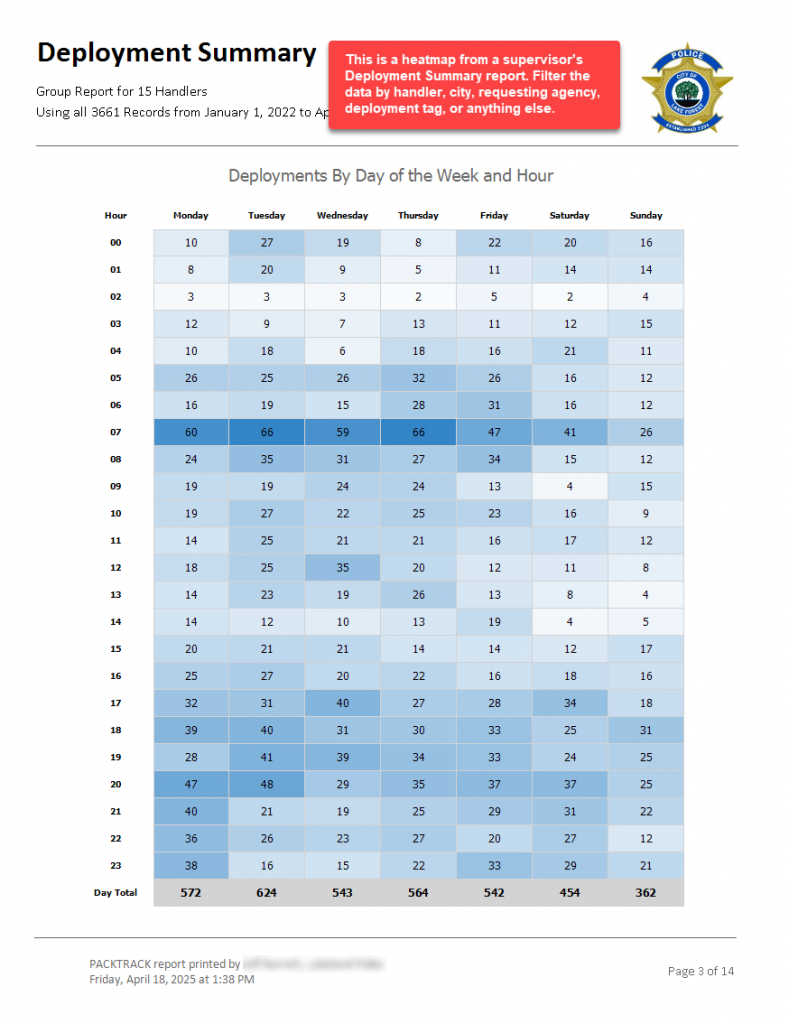
This feature is now live for all handlers and supervisors. Run a Deployment Summary report and check out the new heatmap chart. We'd love to hear what you think.

System Update
0
min read
K9 Veterinary Records
We're excited to announce a powerful new feature for the PACKTRACK K9 record-keeping system: veterinary records. As a K9 handler, keeping accurate health records for your dog is essential, and our latest update makes it easier than ever. With these new features, you can effortlessly track vet visits, vaccinations and medical care, ensuring your dog stays healthy and deployment-ready. Why record your veterinary visits? A healthy dog is a reliable partner, and staying proactive with veterinary care allows you to address medical issues early, ensuring peak performance in the field. Additionally, many agencies and organizations require up-to-date medical records for compliance and documentation. Well-organized records help you make informed decisions about your dog's long-term health and care. With PACKTRACK's new reports, supervisors can easily identify K9s who are overdue for vaccinations, improving accountability.
We're excited to announce a powerful new feature for the PACKTRACK K9 record-keeping system: veterinary records. As a K9 handler, keeping accurate health records for your dog is essential, and our latest update makes it easier than ever. With these new features, you can effortlessly track vet visits, vaccinations and medical care, ensuring your dog stays healthy and deployment-ready. Why record your veterinary visits? A healthy dog is a reliable partner, and staying proactive with veterinary care allows you to address medical issues early, ensuring peak performance in the field. Additionally, many agencies and organizations require up-to-date medical records for compliance and documentation. Well-organized records help you make informed decisions about your dog's long-term health and care. With PACKTRACK's new reports, supervisors can easily identify K9s who are overdue for vaccinations, improving accountability.
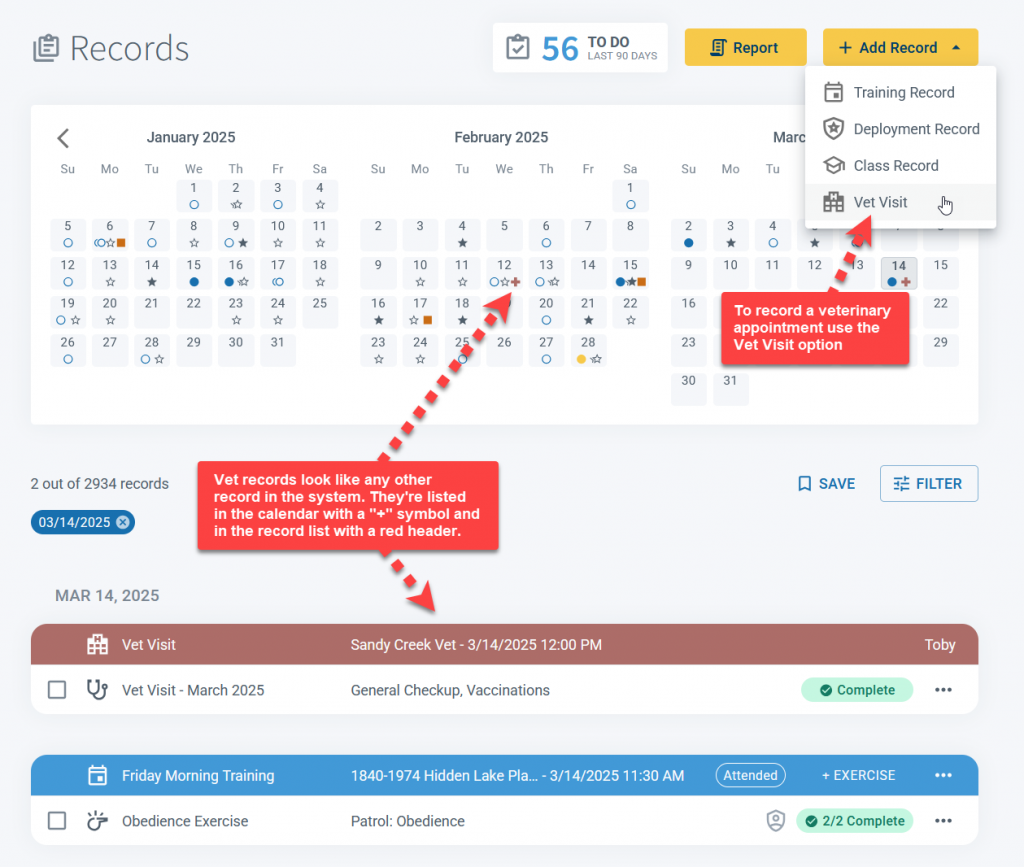
Vet visit records
To log a veterinary appointment you'll use the same familiar interface that you use for recording other activities. Each visit is added to your calendar and record list, allowing you to document past vet visits or schedule upcoming appointments. You can also search your vet records by title, notes, location, or type of care provided.
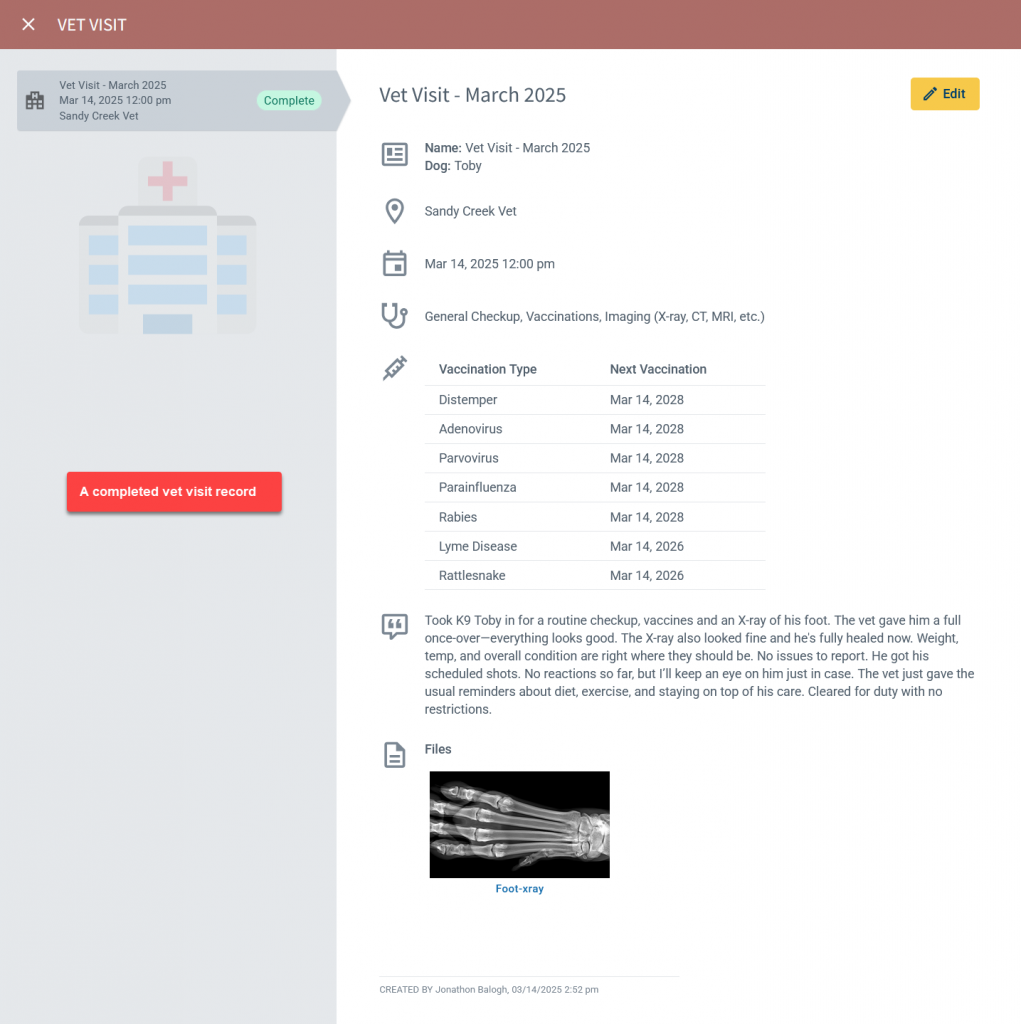
Vet record details
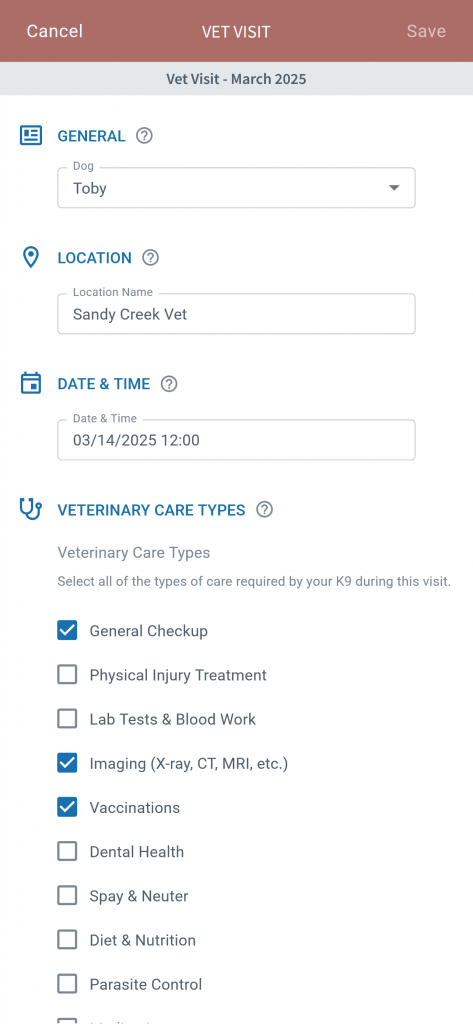
Each vet visit record captures detailed information about the care your K9 receives, creating a complete and organized health history. Log various types of veterinary care, including treatments, vaccinations, X-rays, surgeries, and routine checkups. You can also add detailed notes and attach important documents or medical images to keep everything in one location.
All of this works great in the PACKTRACK app (available for
Vaccination management
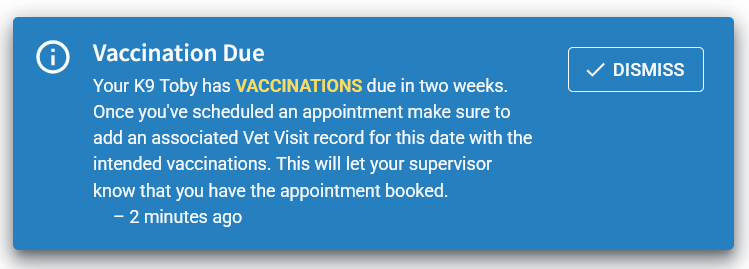
PACKTRACK will alert you when your dog's next vaccine is due, helping you stay proactive about your K9's health. Vaccines fall into two categories: core and non-core. Generally, all dogs should receive the four core vaccines - plus rabies, in most cases - every three years. Additionally, certain non-core vaccines may be recommended based on your K9's location and risk factors, often requiring annual boosters to ensure continued protection.
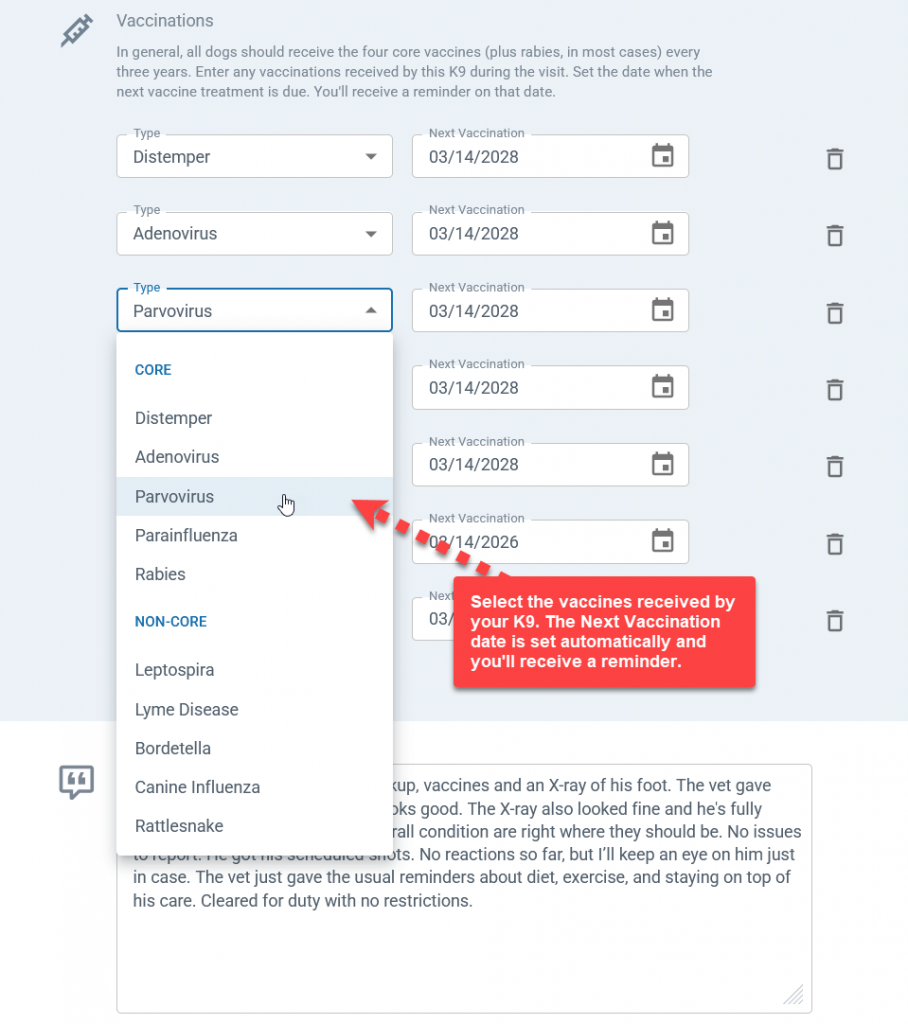
Select your dog's vaccine from the dropdown menu and PACKTRACK will automatically set the next due date based on the vaccine type. You'll receive reminders both in PACKTRACK and via email. This will happen two weeks before the due date and again on the day it's due. These notifications give you plenty of time to schedule an appointment and log the upcoming vet visit in PACKTRACK.
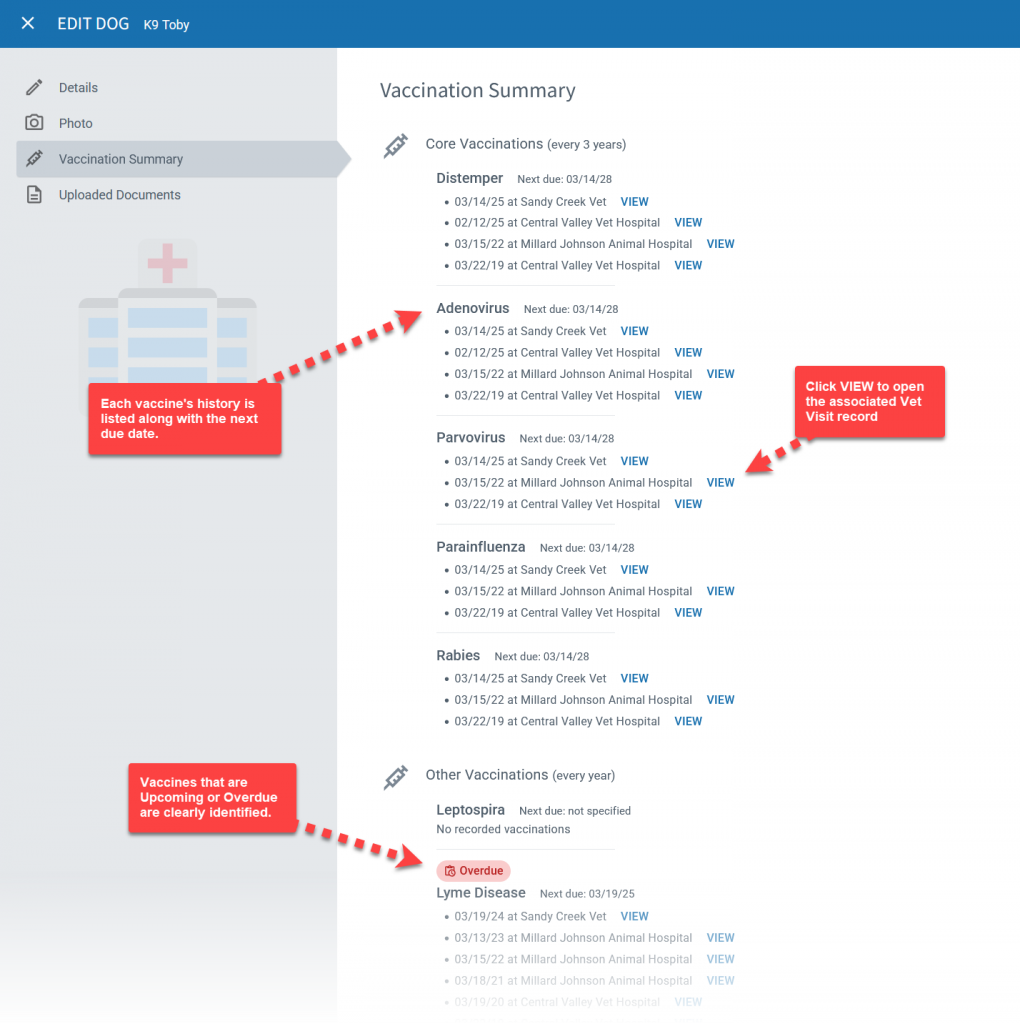
You can view a comprehensive summary of your dog's vaccination history and upcoming due dates at a glance. Each K9 in the Dogs section now gets a dedicated Vaccination Summary page, providing a clear overview of past and upcoming vaccinations. Use the VIEW link to quickly access the corresponding Vet Visit record for more details.
Vet reports
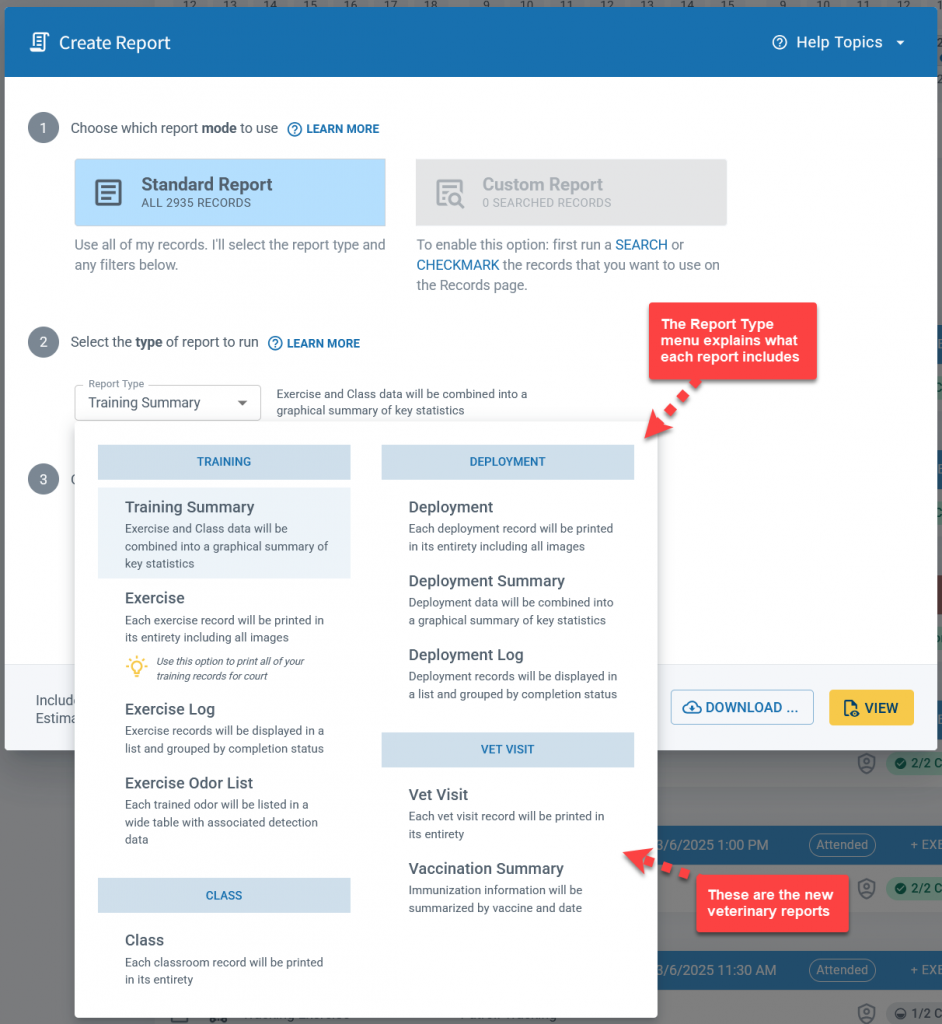
Generate vet visit and vaccine summary reports for a comprehensive view of your K9's medical care. There are 2 new reports available in the Create Report dialog for handlers and supervisors.
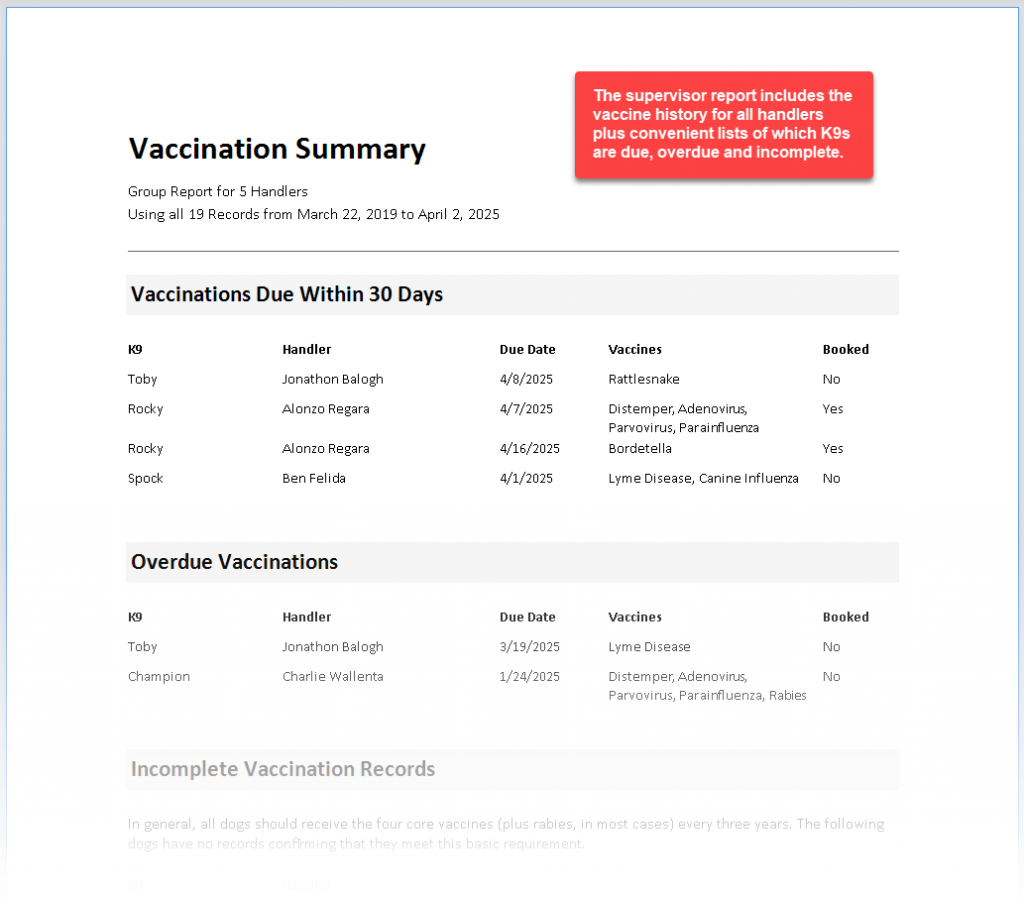
The Vet Visit report includes full details for all veterinary records available in the selected report range. The handler's Vaccination Summary report provides much the same information as the Vaccination Summary page in the Dogs section. Note that it always includes the K9's full vaccination history. The supervisor version of the Vaccination Summary report includes additional details, making it easy to ensure that vaccinations are on schedule. Supervisors can see handlers that have both upcoming and overdue vaccinations as well as whether they've booked appointments. They can also track K9 handlers whose vaccination records are incomplete or missing.
Supervisor oversight
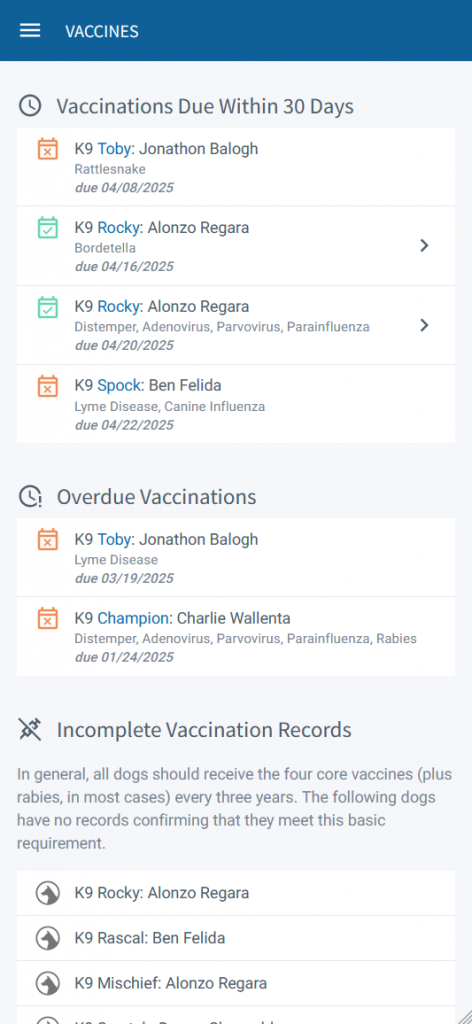
In addition to reports, supervisors have access to a Vaccines page with similar summaries of key vaccination information. The TO DO card on the Records page alerts the supervisor when there are overdue vaccinations for any supervised handler's K9.
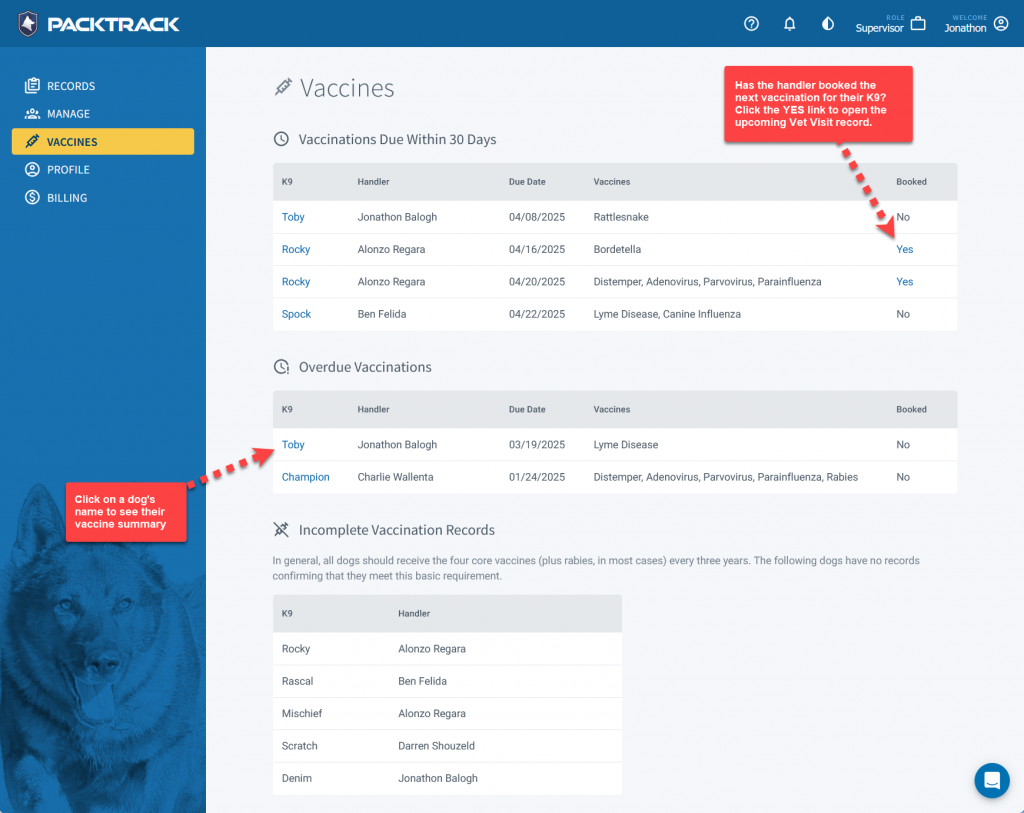
The Vaccines page is also available to supervisors within the PACKTRACK app.
We strive to make PACKTRACK powerful, yet user-friendly. Explore the new veterinary records functionality and share your feedback — we'd love to hear your thoughts!

System Update
0
min read
Tag Your K9 Records
Keeping your K9 records organized makes it easier to find what you need quickly and one of the simplest ways to categorize your work is by using a tagging system. We just updated PACKTRACK with more tagging features, including support for tags in deployments. Read on to learn more.
Keeping your K9 records organized makes it easier to find what you need quickly and one of the simplest ways to categorize your work is by using a tagging system. We just updated PACKTRACK with more tagging features, including support for tags in deployments. Read on to learn more.
What are tags?
Tags are custom labels that you can attach to your K9 training event and deployment records to filter information more efficiently. Unlike rigid folder structures, tags offer flexibility, allowing you to label records with multiple relevant terms of your own choosing. For example, for a training session, you might add an event tag like "Demonstration" or "Certification". Later, when you need to see all of your demonstration records you can simply search for the appropriate tag name rather than digging through your records manually.
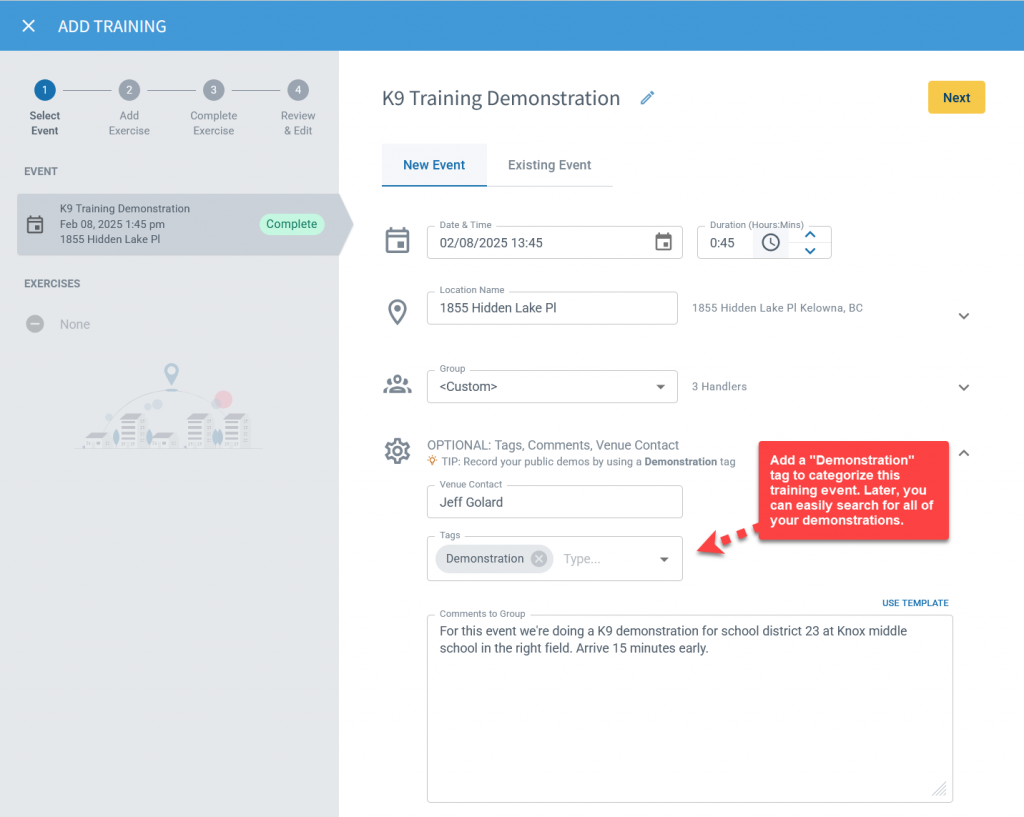
How tags work
PACKTRACK now supports tagging for training events and deployment records. If you have a record of a certain type that you'd like to label then use the Tags dropdown to choose an entry or type in your own term. Custom tags are automatically listed in the dropdown the next time you use it. Feel free to add as many tags as you need. For deployments, we've provided a few default options including Overtime, Off Duty, Call Out, Burglary, Armed Robbery and Felony. Default training event tags include: Demonstration, Scent Wall and Certification.
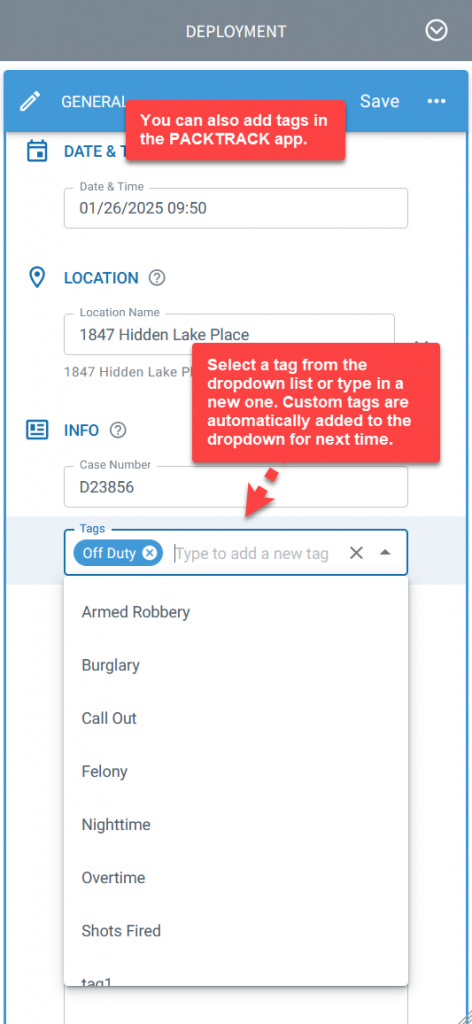
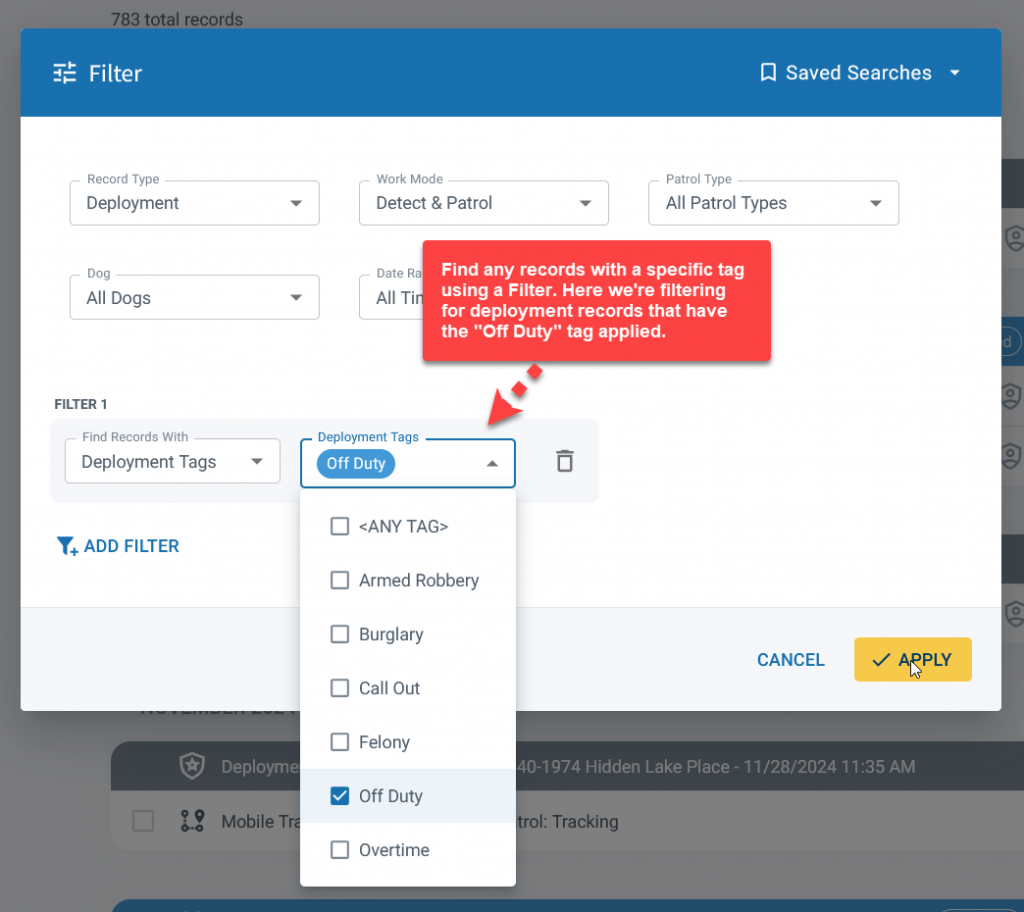
How do you find these records later? Let's say you've been regularly tracking your off duty deployments by setting the "Off Duty" tag for each record. You can search for these deployments using the record Filter button. In the dialog that appears, choose the Add Filter option and then select the Deployment Tags criteria. Next, choose the "Off Duty" tag and then hit Apply. Your record list is now filtered to only show your off duty deployments. You can easily run reports on these specific records using the Report button. Also note that the filtering dropdown has an option for "
<
Any Tag
>
". Choose this to find all deployments that have any tag at all.
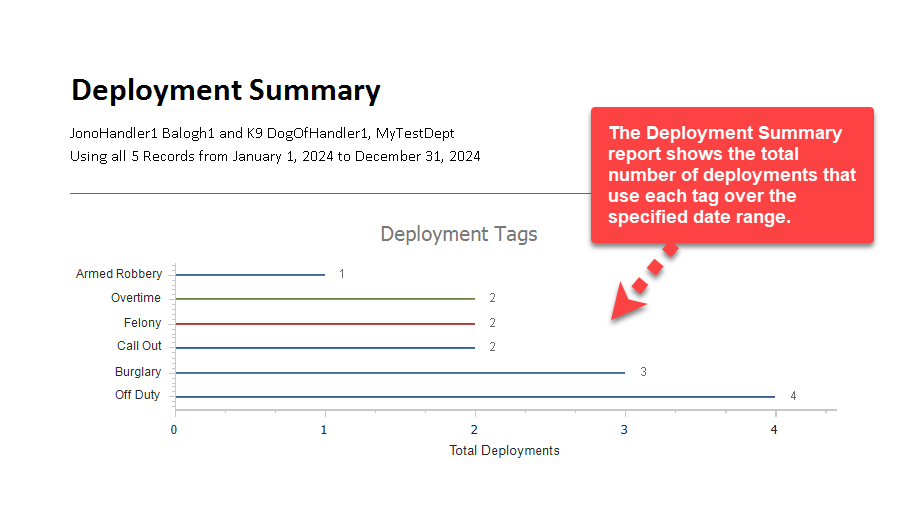
Tags are counted and displayed in the Training Summary and Deployment Summary reports. To determine how many off duty deployments you completed in 2024, for example, you would run a Deployment Summary report for that date range. A convenient bar graph shows the total number of times each tag was applied to a deployment.
If you're not already using tags in PACKTRACK then now is the time to start. Whether you're tracking your training certifications or overtime deployments, using a robust tagging system will help you maintain better organization, retrieve data quickly and gain valuable insights.
System Update
0
min read
Tracking System Updates
This past summer we introduced our latest K9 location tracking system with a new interface and several new features. In this release we've made a number of important improvements to make tracking even better.
This past summer we introduced our latest K9 location tracking system with a new interface and several new features. In this release we've made a number of important improvements to make tracking even better.
Filtering
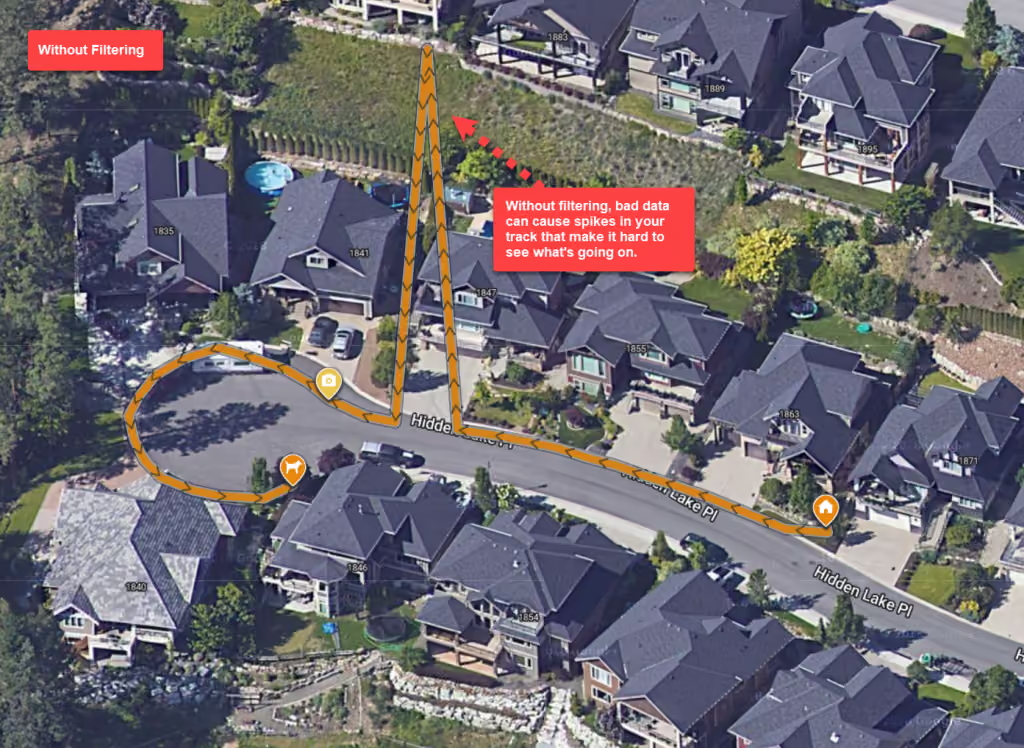
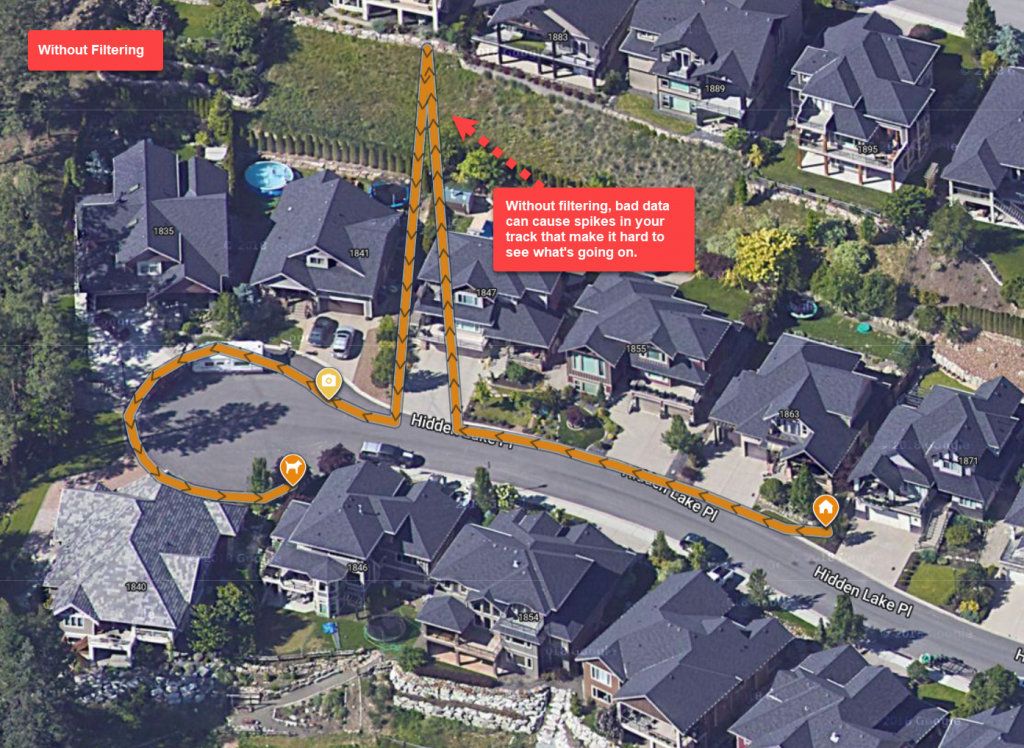
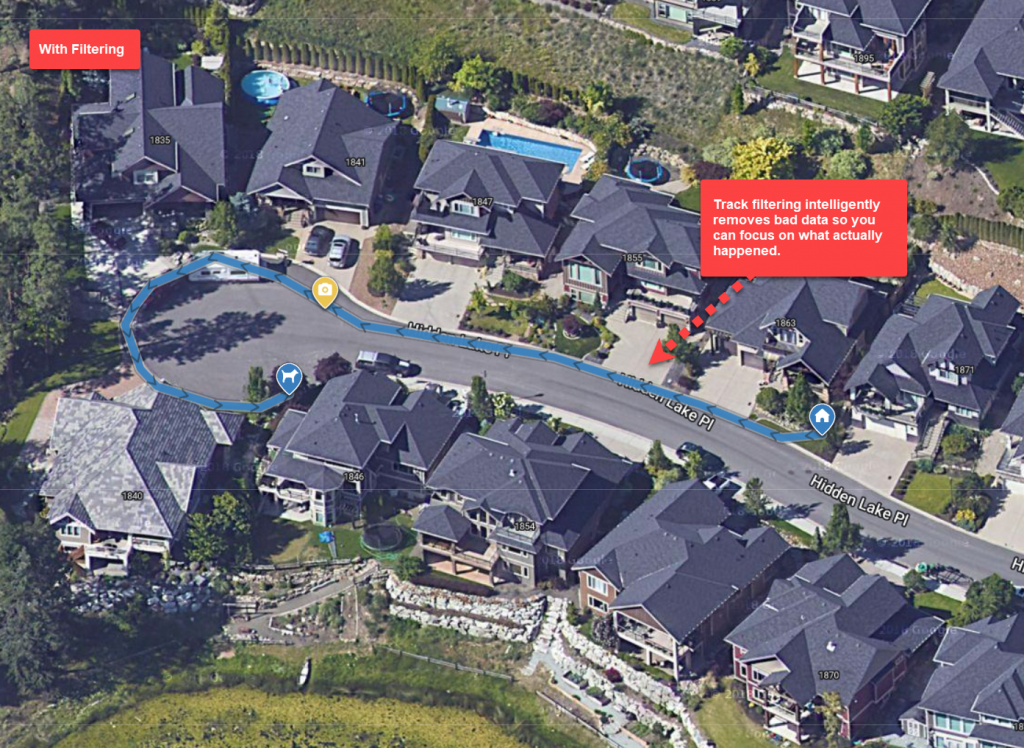
The first major change is track filtering. GPS data isn't always accurate, especially in thick trees or next to buildings. This update uses advanced filtering to hide bad data so that there are fewer spikes on the route. This gives you a smoother, more consistent looking track, even in challenging conditions.
Improved orientation
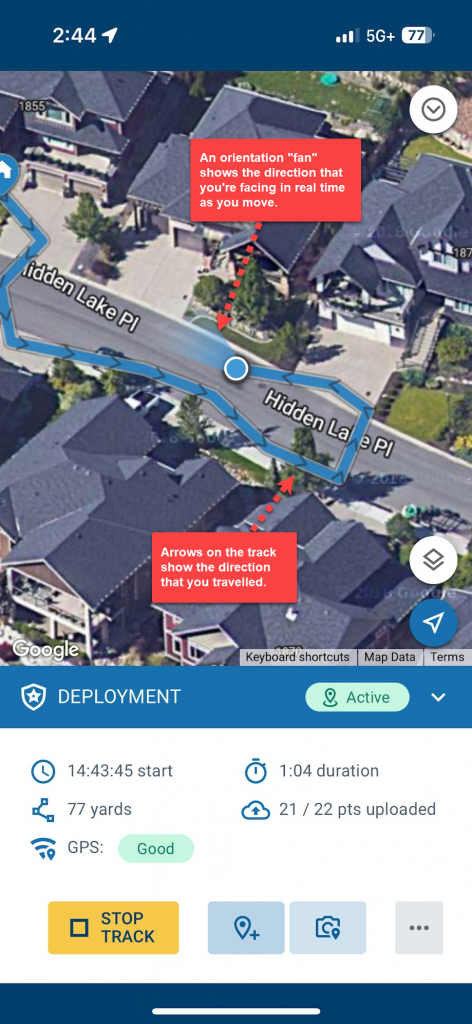
A line on a map shows you where you've gone but the direction that you've travelled isn't always obvious. As of this release, all track paths include integrated direction arrows to make this more clear. We've also added an orientation indicator so you can see which direction you're facing. This blue "fan" spins to show your current direction on the map in real time and makes it much easier to get your bearing. This can be invaluable, especially when you're in a hurry and need to know which way is up. For now, the orientation feature is only available on iPhones.
Enhancements
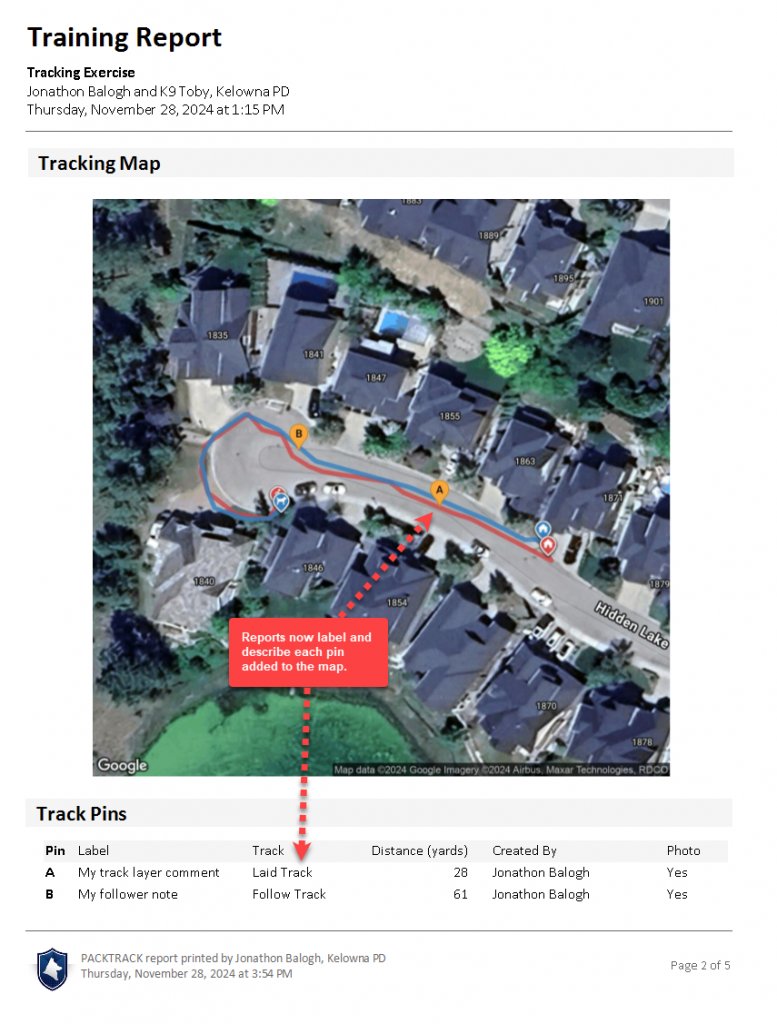
This release includes dozens of minor location tracking enhancements. Tracking reports are now more informative with a detailed breakdown of all track pins. The History page records all track interactions. We've made several enhancements to the tracking map window to make it easier to use and more intuitive. And along the way we squashed a bunch of small bugs and made changes to improve reliability. This release also includes a new version of the PACKTRACK app which restores the back button functionality for Android users.
The PACKTRACK app will update to the new version automatically over the coming week or so but feel free to download the latest version from your app store now. We love hearing your feedback. Please let us know if these features are working well for you or something doesn't function as expected. We're here to help.
Explore PACKTRACK
Get a closer look at record keeping, reporting, unit oversight, training groups, and integrated GPS track mapping, and see how it fits into your workflow.